Long before any flag existed on what is now Angolan soil, powerful states flourished here. The greatest of them was the Kingdom of Kongo — from the 14th to the 19th century it stretched from northern Angola into what are now the two Congo republics. Portuguese navigator Diogo Cão landed on the coast in 1484, and trade relations between Portugal and Kongo were soon established. In 1575, Portugal founded Luanda — the city that remains Angola's capital to this day. Throughout the 16th to 19th centuries Angola became one of the main hubs of the transatlantic slave trade: by various estimates, as many as 4 million people were shipped through its ports.
During Portuguese colonial rule (1575–1975) there was, of course, no Angolan flag — the territory flew the flag of Portugal, while administrative structures used colonial coats of arms.
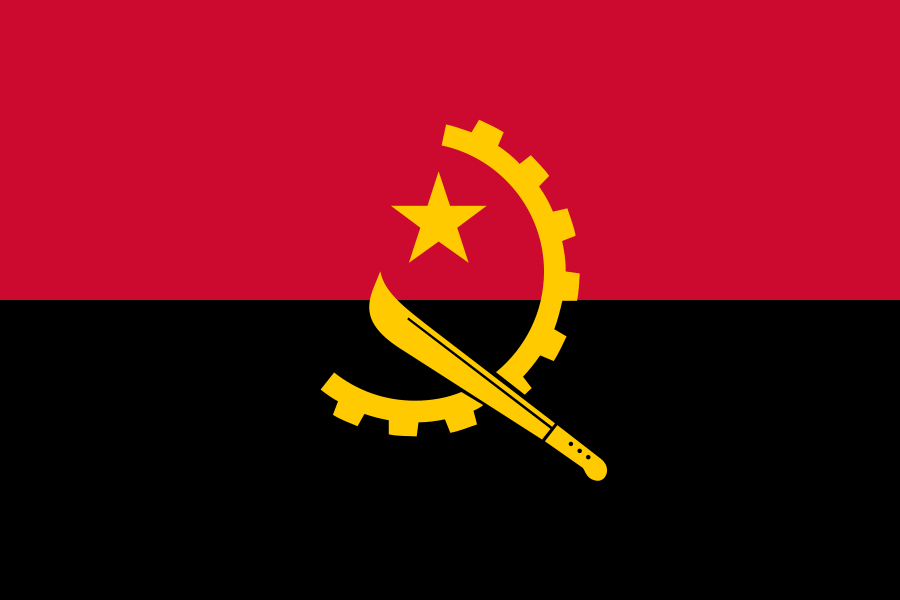
In 1956 the MPLA — People's Movement for the Liberation of Angola — was founded in Luanda. The organization quickly became the leading force of anti-colonial resistance, drawing its support primarily from the Mbundu people and the urban intelligentsia. In 1961 the MPLA launched its armed struggle, and it was then that the movement's first flag appeared: a red-over-black field with a yellow star at the center. Two other movements operated in parallel: the FNLA (National Front for the Liberation of Angola), led by Holden Roberto, and UNITA, founded in 1966 by Jonas Savimbi.
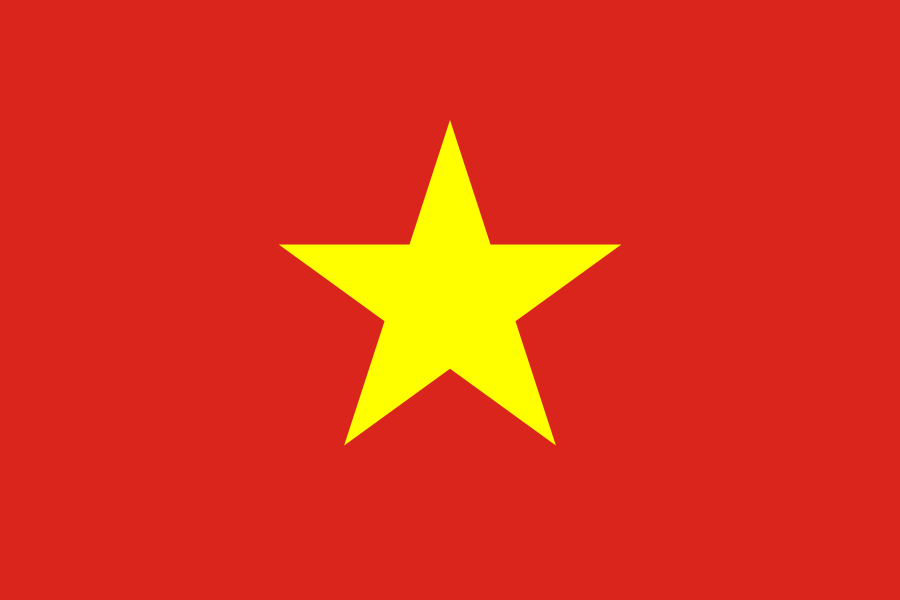
Some vexillologists point to a resemblance between the MPLA flag and the Viet Cong flag — a red-over-blue field with a yellow star. Whether the MPLA consciously modeled itself on that design or whether the similarity simply reflects the shared visual language of left-wing movements of that era remains an open question, and both interpretations deserve mention.
On April 25, 1974, young Portuguese officers overthrew the dictatorship in Lisbon. The so-called Carnation Revolution brought down the Estado Novo regime, which had refused to relinquish its colonies. Already in January 1975, the three Angolan movements signed the Alvor Agreement, establishing a transitional government and setting the date of independence: November 11, 1975.
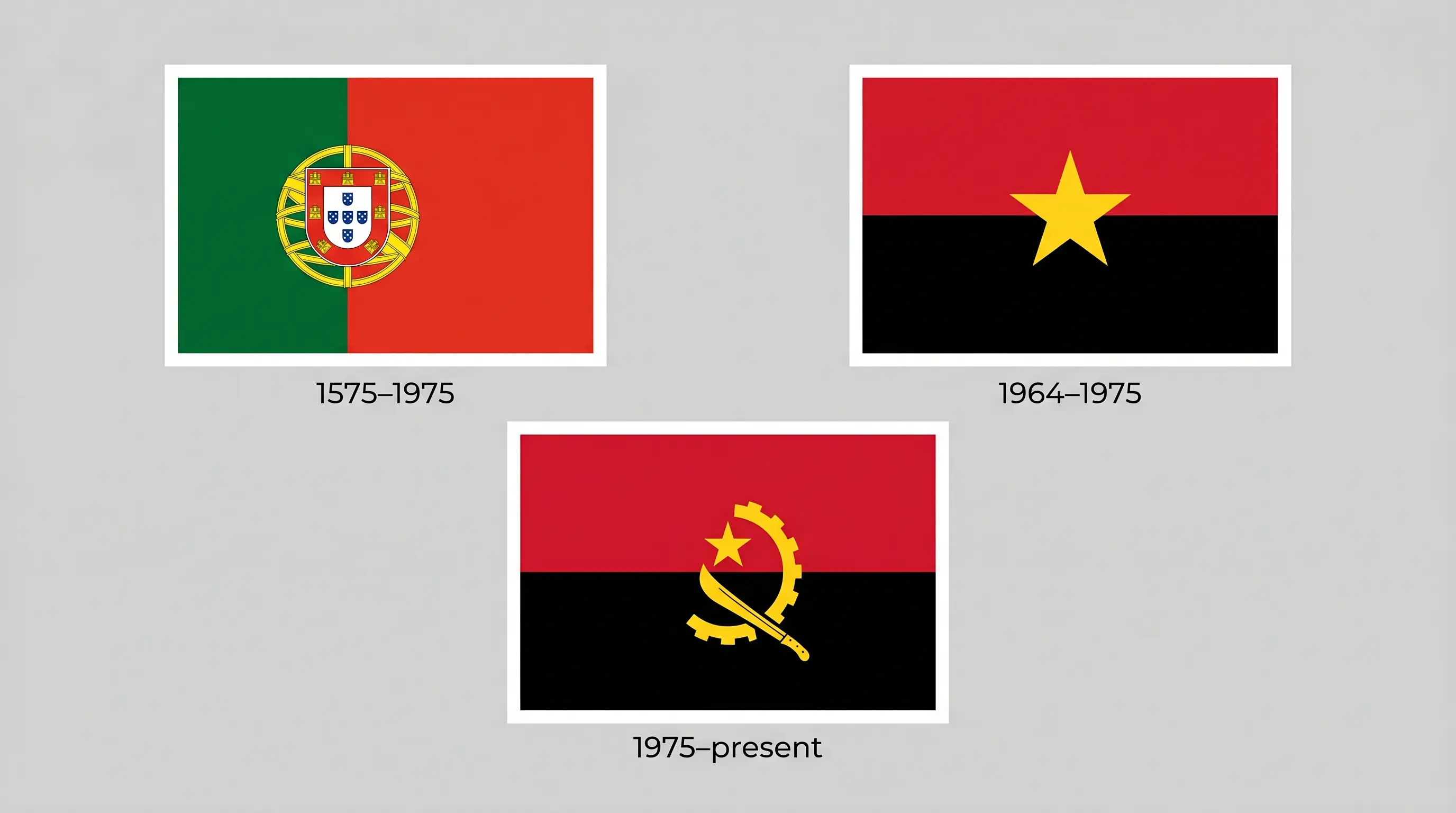
But the ceasefire was short-lived. In July 1975 the MPLA drove the FNLA from Luanda; UNITA withdrew voluntarily to the south. The lines of conflict brought in far more than Angolans: the United States and Zaire backed the FNLA and UNITA, the Soviet Union and Cuba backed the MPLA. In the south, South African units were operating. On November 10, 1975, the Portuguese left Luanda without transferring power to any particular side. At midnight on November 11, MPLA leader Agostinho Neto proclaimed the independence of the People's Republic of Angola — and that same night, Joaquina, Ruth Lara, and Cici Cabral hand-sewed the first official flag of the new state.
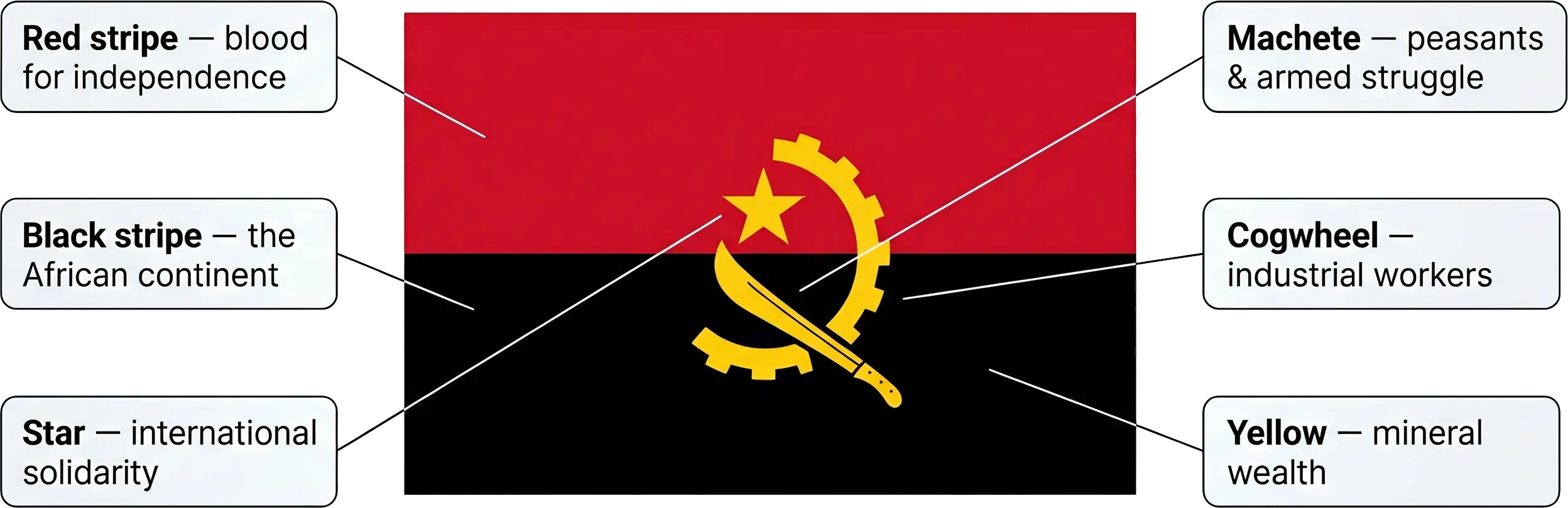
Independence did not bring peace. The civil war between the MPLA and UNITA lasted 27 years — until Jonas Savimbi was killed on February 22, 2002. Throughout that time the flag remained unchanged, though the 1992 constitution rewrote its language: "revolution" became "defense of the country," and "internationalism" became "international solidarity." After the war ended, in 2003 parliament considered changing the flag as a gesture of reconciliation and to distance the country from Marxist symbolism. A design competition was held, and the winning entry was submitted under the pseudonym "Catica": three horizontal stripes of blue, white, and red with a golden sun at the center, drawn from ancient rock paintings at the Tchitundu-Hulu site in Namibe Province. The proposal was nonetheless rejected: a large portion of Angolan society felt that changing the flag would erase the memory of the independence struggle.