Pre-colonial era. Long before European contact, the territory of today's Burundi was organised as the Kingdom of Burundi (Ubwami bw'Uburundi), one of the most centralised states of the African Great Lakes region. It emerged around the 17th century under the mwami (king) Ntare Rushatsi and was ruled by the Ganwa princely class. As in most Great Lakes monarchies, royal authority was expressed through ritual objects — sacred drums (karyenda), spears and royal regalia — rather than through a flag in the European sense. The drum, in particular, served as the supreme symbol of the kingdom and of the mwami's power.
German and Belgian colonisation (1890s–1962). From 1890 the kingdom was incorporated into German East Africa as part of Ruanda-Urundi. After Germany's defeat in the First World War, the League of Nations placed the territory under Belgian mandate in 1922, later converted into a UN trust territory in 1946. Throughout this period Burundi had no flag of its own as a colony — official representation was carried out through the German imperial flag and later the Belgian tricolour. The traditional monarchy was preserved in a heavily restructured form under indirect rule.
Independence and the monarchical flag (1962–1966). Burundi gained independence on 1 July 1962 as a constitutional monarchy under mwami Mwambutsa IV Bangiriceng. The first national flag, adopted on 28 June 1962, already used the white saltire on red and green fields, but at its centre it displayed the royal emblem: a sacred karyenda drum, in front of which stood a sorghum plant — both deeply rooted symbols of the kingdom. The death of Prince Louis Rwagasore, the popular independence leader assassinated in October 1961, cast a long shadow over the young state, and tensions between the monarchy and the parliament grew rapidly.
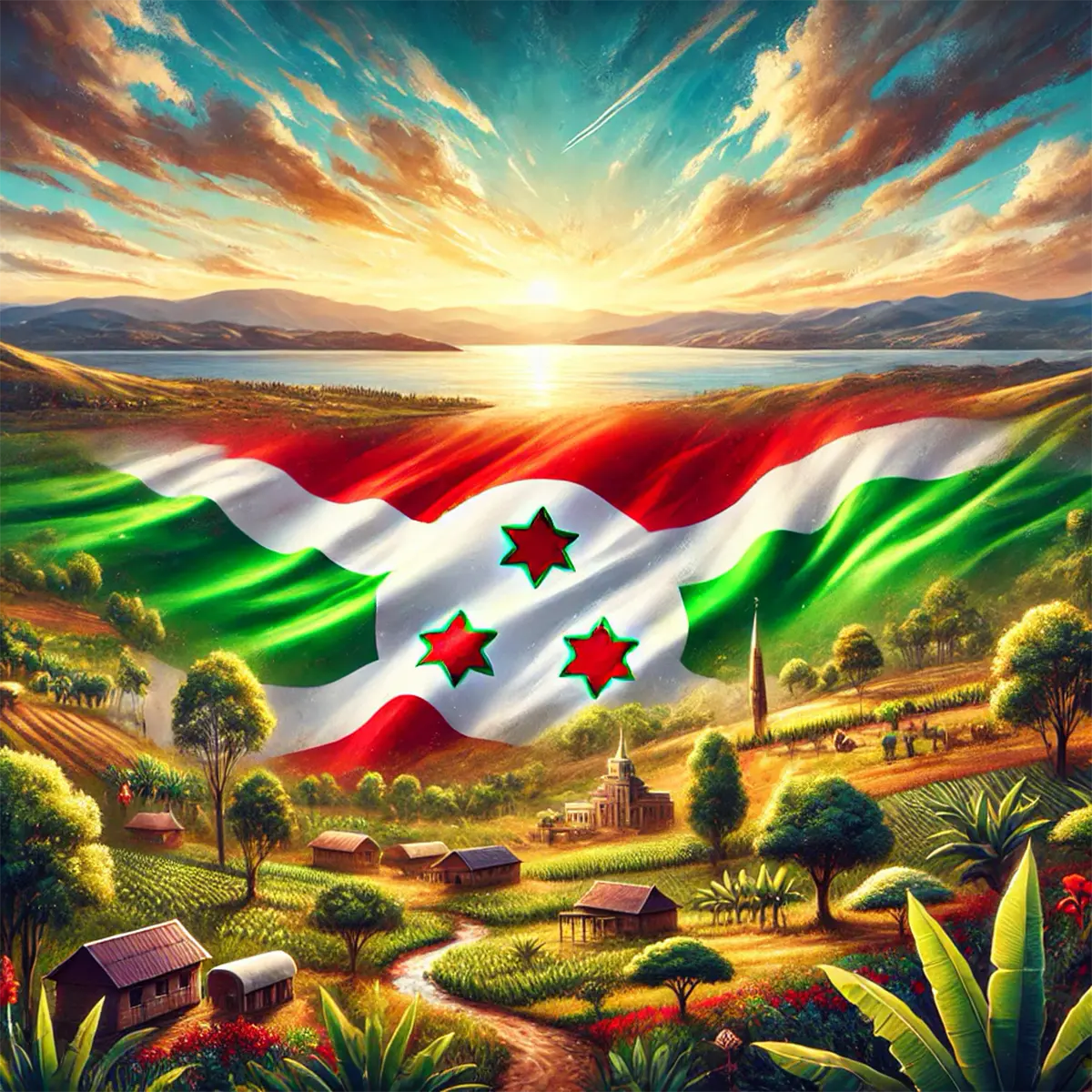
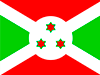
From monarchy to republic (1966–1967). In July 1966, in the midst of a constitutional crisis, Crown Prince Charles Ndizeye deposed his father and was briefly enthroned as mwami Ntare V. Only a few months later, on 28 November 1966, Prime Minister Captain Michel Micombero abolished the monarchy altogether and proclaimed the First Republic, declaring himself president. The monarchical drum and sorghum were now politically incompatible with the new regime. On 28 June 1967, a new flag was adopted: the saltire and colours were kept, but the royal emblem was replaced by a white disc bearing three red six-pointed stars outlined in green. The number of stars and their meaning were officially linked to the motto "Unity, Work, Progress" and, by extension, to the three communities of the country.
1982 standardisation. The basic design has remained essentially unchanged since 1967, but on 27 September 1982 the flag was officially formalised, with its 3:5 ratio codified and the size, position and outlining of the stars precisely defined. Earlier versions of the republican flag had sometimes shown slight variations in proportion and in the rendering of the stars. The 1982 specifications remain in force today.
From civil war to the present. The flag flew over Burundi through some of the country's most tragic chapters: the ethnic massacres of 1972, the assassination of President Melchior Ndadaye in 1993 and the civil war of 1993–2005, which left an estimated 300,000 dead. Despite repeated regime changes — Pierre Buyoya, Melchior Ndadaye, Cyprien Ntaryamira, Sylvestre Ntibantunganya, Pierre Nkurunziza, Évariste Ndayishimiye — and the relocation of the political capital from Bujumbura to Gitega in 2019, the flag itself has not been altered. Today it remains a strong symbol of national continuity and of the ideal of unity in a country still working through the long aftermath of its conflicts.