Pre-colonial era and the Kingdom of Dahomey. Before the arrival of Europeans, the territory of modern Benin was home to the powerful Kingdom of Dahomey (17th–19th centuries) with its capital at Abomey. It did not use European-style flags, but it had a rich tradition of appliqué cloths — symbolic fabric panels depicting kings and events that served a heraldic function. The famous emblems of the Dahomean kings — the lion, the shark and the buffalo — come from this tradition.
French colonization (1894–1958). In 1894 Dahomey was definitively conquered by France and incorporated into French West Africa. The territory flew the flag of the French Republic — the blue-white-red tricolor — and the colony of Dahomey had no flag of its own.
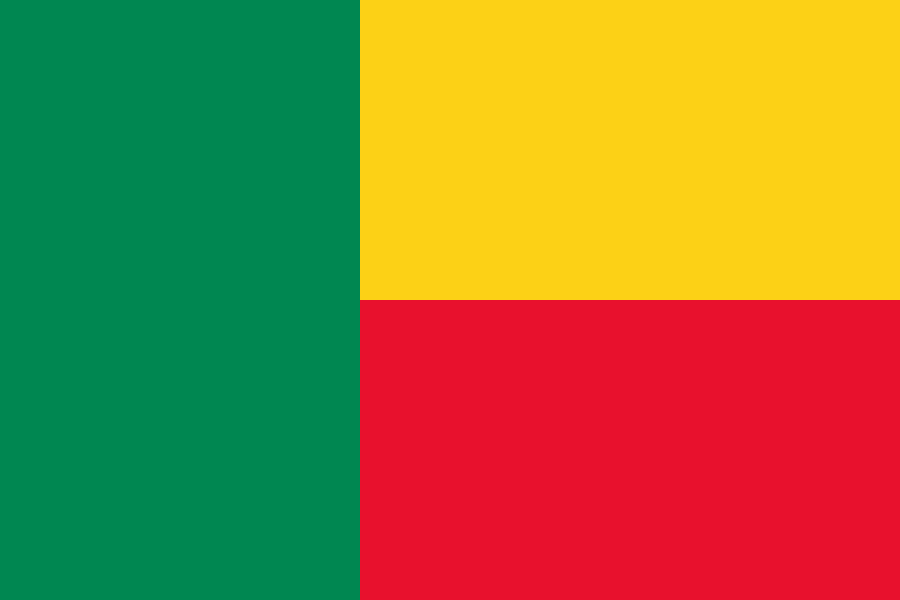
Autonomy and the birth of the national flag (1958–1959). On 4 December 1958 Dahomey became an autonomous republic within the French Community. Just under a year later, on 16 November 1959, the Constituent Assembly approved the current design. The choice of Pan-African colors deliberately referenced Ethiopia as a symbol of African freedom and Ghana, which had gained independence in 1957.
Independence in 1960. On 1 August 1960 Dahomey declared independence from France, and the flag adopted the year before automatically became the state flag. The first years of independence brought a string of military coups, but the flag itself remained unchanged.
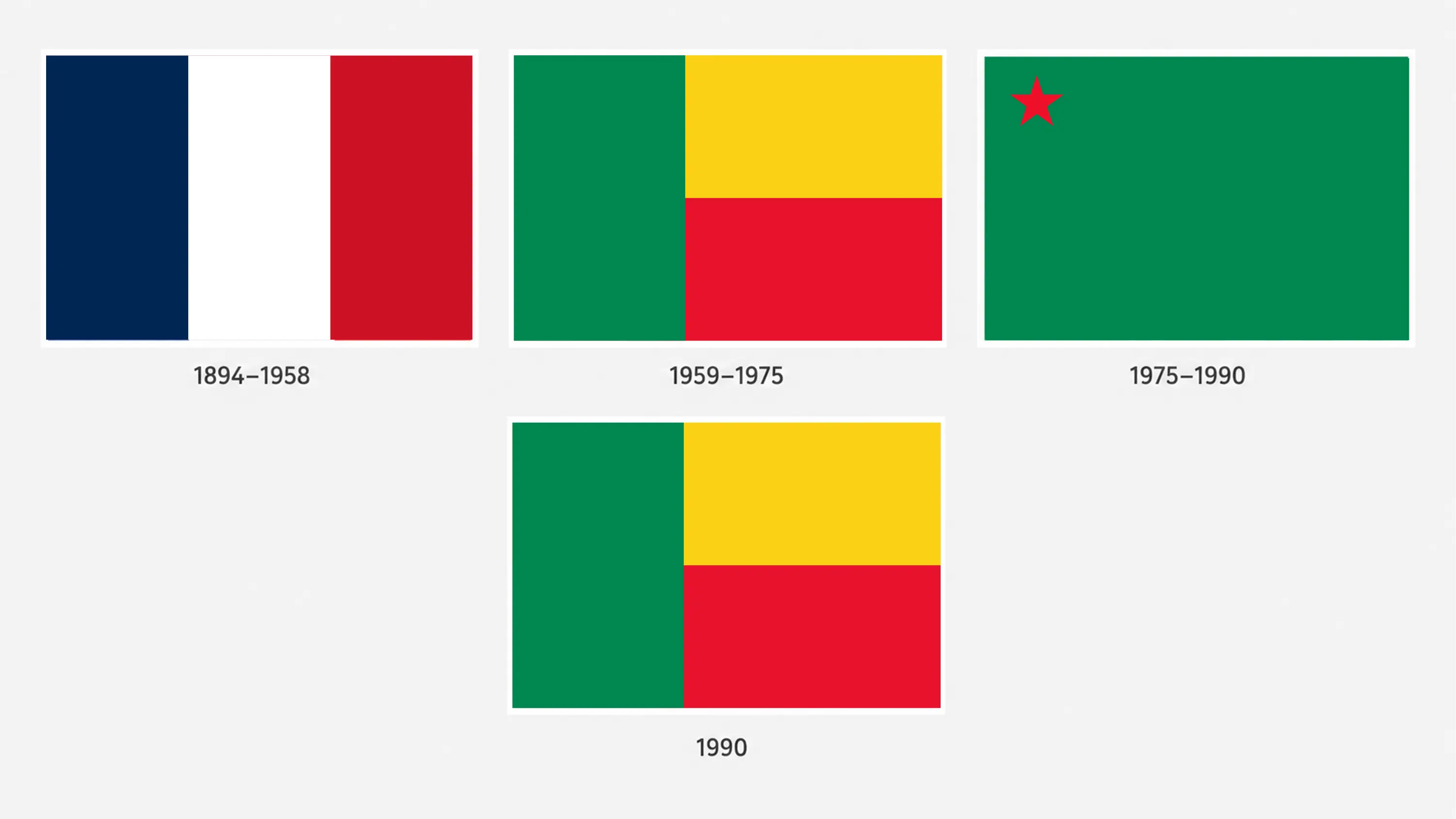
People's Republic of Benin (1975–1990). On 30 November 1975 the regime of Mathieu Kérékou, who had taken power in the 1972 coup, proclaimed the People's Republic of Benin and adopted Marxism-Leninism as the official ideology. The old name "Dahomey" was replaced with "Benin" (after the historic bight, not the Nigerian city), and the flag was changed completely: it became solid green with a red five-pointed star in the upper hoist canton — a symbol of revolution and the country's "socialist future." This flag was used for almost 15 years.
Restoration of the flag in 1990. By the late 1980s the regime faced an economic crisis and mass protests. In February 1990 the National Conference of the Active Forces of the Nation in Cotonou effectively dismantled the one-party system. On 1 August 1990, the 30th anniversary of independence, the country officially restored the 1959 flag — without any modification. This symbolized a clean break with the Marxist era and a return to the original ideals of independence.
Current status. The flag has not been changed since 1990. Its design is enshrined in the 1990 Constitution of Benin and in the relevant laws on state symbols. Alongside the flag, the country uses the coat of arms of Benin and the anthem "L'Aube nouvelle" ("The New Dawn") as official symbols.