Flag of the Central African Republic

Artistic representation "Flag of the Central African Republic"
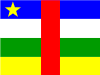
The flag of the Central African Republic is one of the most symbolically rich on the continent. Barthélemy Boganda envisioned it as a political statement: the four African states he dreamed of uniting into the "United States of Latin Africa", along with the preservation of ties with France. Each color carries a specific meaning rooted in national tradition.
Blue — represents the sky and freedom. In Boganda's vision it was also a deliberate reference to the blue of the French flag, signifying the preservation of cultural and political ties with the former metropole. Independently, the blue stripe symbolizes the sky over Africa as a shared space for all its peoples.
White — stands for peace, dignity and racial equality. Boganda, who personally championed coexistence between Africans and Europeans, gave this color particular weight. White is also traditionally interpreted as a sign of honesty and the purity of intent of the young nation.
Green — represents the forests, nature and hope. The CAR is covered by tropical forest across much of its territory, so green carries not only symbolic but also literal geographical meaning. In vexillology, green is traditionally associated with hope for the future.
Yellow — symbolizes the northern savannas, tolerance and the wealth of the land. Yellow also links the flag to the broader Pan-African color palette pioneered by the flag of Ethiopia.
The vertical red stripe — the most distinctive element of the flag. It crosses all four horizontal stripes through the middle, symbolizing the blood shed for independence and the unity of European and African blood. Boganda famously said that this stripe is a reminder that "Europeans and Africans must respect each other's blood." It is both physically and symbolically the unifying element of the flag.
The yellow five-pointed star in the upper-left corner — a symbol of independence and the aspiration to freedom. The star points toward the nation's future and its path of development. In some readings, it also represents the leading role Boganda envisioned for the CAR in the unification of French-speaking Central African territories.
Pre-colonial period and French colonization
Before the arrival of Europeans, the territory of modern CAR was home to a range of ethnic groups — Banda, Gbaya, Zande, Sara and others. No unified state symbols covering the whole territory existed. In 1894 France established control over the region, which became known as Ubangi-Shari after its two main rivers. In 1903 the territory became a separate colony, and from 1910 it was part of French Equatorial Africa together with Chad, Gabon and Middle Congo. Throughout this period the French tricolor served as the official flag.
The path to autonomy and Boganda's project
After the Second World War the process of decolonization began. In 1946 Barthélemy Boganda became the first African from Ubangi-Shari elected to the French parliament. He founded the MESAN movement (Mouvement pour l'évolution sociale de l'Afrique noire) and advocated not just for the independence of his own territory but for the creation of a large federation — the United States of Latin Africa, which would unite Ubangi-Shari, Chad, Gabon and Middle Congo.
Adoption of the flag in 1958
On 1 December 1958 Ubangi-Shari was granted autonomy within the French Community and became the Central African Republic. On the same day a new flag, designed personally by Boganda, was adopted. He deliberately combined the Pan-African colors (red, yellow, green) with those of France (blue, white, red) to emphasize that the new country was not severing ties with its European heritage but at the same time embracing its African identity. This design was unprecedented and remains one of a kind among national flags of the world.
Independence and the Boganda tragedy
On 29 March 1959 Boganda died in a plane crash under circumstances that were never fully clarified. His dream of a federation never materialized — the other territories chose separate independence. On 13 August 1960 the CAR officially proclaimed independence under David Dacko, Boganda's nephew. Despite the collapse of the federalist project, the flag was kept unchanged as a tribute to its creator.
The Bokassa era and the "Central African Empire"
In 1965 power was seized by Jean-Bédel Bokassa. In 1976 he proclaimed himself emperor, renamed the country the Central African Empire, and in December 1977 staged a Napoleon-style coronation that reportedly consumed around a quarter of the country's annual budget. Yet even during the empire the national flag remained unchanged — Bokassa kept Boganda's design, adding only a personal imperial standard for his own use. In September 1979 Bokassa was overthrown, the empire was abolished, the republic was restored — and the flag continued to serve without any modification.
Modern period
From 1979 to the present the CAR flag has remained exactly as Boganda designed it in 1958. The country has lived through several coups, civil war, and the crises of 2013 and 2020, but the flag has remained a unifying national symbol. It is enshrined in the 2016 Constitution as one of the state symbols alongside the coat of arms, the anthem "La Renaissance" and the national motto "Unité, Dignité, Travail" ("Unity, Dignity, Work").