Pre-colonial banners and the French period
Before colonization, the territory of present-day Congo-Brazzaville was home to the Kingdom of Kongo, the Loango Kingdom and the Teke confederation. These polities used royal standards, ceremonial cloths and emblems of office, but no single "national" flag existed in the modern sense. From 1880, after the treaty between the Teke king Makoko and the explorer Pierre Savorgnan de Brazza, the area came under French control and was eventually incorporated into French Equatorial Africa (AEF) in 1910, with Brazzaville as the federal capital. Throughout this period the only official flag was the French tricolour.
The 1959 flag and independence
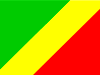
On 28 November 1958, the territory became an autonomous republic within the French Community. Less than a year later, on 18 August 1959, the new Republic adopted its national flag: green-yellow-red on the diagonal. The choice of pan-African colors aligned Congo with Ghana, Guinea and other newly independent African states, while the diagonal layout gave it a unique identity. On 15 August 1960, the country gained full independence under President Fulbert Youlou, and the 1959 flag became the flag of the sovereign state.
The Marxist period and the flag of 1970–1991
After the 1968 coup led by Marien Ngouabi, Congo became, on 31 December 1969, the People's Republic of the Congo — the first Marxist-Leninist state in Africa. On 30 December 1970, a new flag was adopted: a red field with the national emblem in the upper hoist (a crossed hoe and hammer inside a wreath of palm leaves, surmounted by a yellow star). The colour scheme directly echoed the communist flags of the era, and the green-yellow-red of independence disappeared for two decades. The state was renamed Congolese Workers' Party (PCT) rule, and the red banner flew over Brazzaville from 1970 until the early 1990s.
1991 restoration
The collapse of the Soviet bloc and growing internal pressure forced President Denis Sassou Nguesso to convene the Sovereign National Conference in 1991, which dismantled the one-party state and renamed the country back to the Republic of the Congo. On 10 June 1991, the Conference formally restored the original 1959 diagonal flag. It has remained the national flag ever since, surviving the civil wars of 1993–1994 and 1997–1999, the return of Sassou Nguesso to power in 1997, and the constitutional revisions of 2002 and 2015.
Modern usage
The flag is enshrined in the current constitution alongside the coat of arms, the national motto "Unité, Travail, Progrès" ("Unity, Work, Progress") and the anthem La Congolaise, which was itself adopted in 1959, dropped in 1969 and restored in 1991 together with the flag. It flies over the Palais du Peuple in Brazzaville, the seat of the President, and is displayed at every official ceremony, sporting event and diplomatic mission of the Republic of the Congo.