Pre-colonial banners and the kingdoms of the interior
Before French colonization, the area now called Côte d'Ivoire was a mosaic of kingdoms and chieftaincies — the Kong Empire in the north, the Baoulé kingdom of Queen Pokou in the centre, the Agni kingdoms of Sanwi and Indénié in the east, and various coastal polities. These states used royal stools, ceremonial swords, gold weights and fabric standards as emblems of authority, but no unified «national flag» in the modern sense existed. Cloth itself, especially the woven kita and the printed pagne, carried strong identity meanings that would later inform the visual culture of the independent state.
French colonization and the AOF period
The French presence began in earnest in the 1840s with trading posts on the Gulf of Guinea, and in 1893 Côte d'Ivoire became a separate French colony, later integrated into French West Africa (Afrique Occidentale Française, AOF) in 1904. Throughout this period the only official flag was the French tricolour. Brazzaville-style colonial reforms after World War II progressively widened African political participation, and in 1958 the colony voted in favour of the Fifth Republic referendum, becoming an autonomous republic within the French Community on 4 December 1958.
Adoption of the national flag in 1959
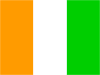
The flag was adopted by Law No. 59-240 of 3 December 1959, voted by the Legislative Assembly of the autonomous republic. The government of Houphouët-Boigny — at that point still Prime Minister — chose a design that explicitly mirrored the French tricolour structure, signalling continuity with Paris within the framework of the French Community, while the orange-white-green palette gave the flag its African identity. Independence followed less than a year later, on 7 August 1960, and the 1959 flag became the flag of the sovereign state without modification.
Stability of the design
Unlike many African states that revised their flags after coups or regime changes, Côte d'Ivoire has kept exactly the same flag since 1959. It survived the long single-party rule of Houphouët-Boigny (1960–1993), the political transition under Henri Konan Bédié, the military coup of December 1999 led by General Robert Guéï, the 2002 rebellion that split the country in two, the post-electoral crisis of 2010–2011 between Laurent Gbagbo and Alassane Ouattara, and the subsequent reunification — without any of these upheavals producing a redesign. This longevity is itself politically significant: the flag is one of the very few national symbols that all factions across Ivorian history have continued to recognize.
The Ireland confusion
The flag is famously almost a mirror image of the flag of Ireland, which is also a vertical tricolour of green-white-orange but with green on the hoist and orange on the fly. The two are independent creations — Ireland's tricolour dates back to 1848 and was officially adopted in 1937, well before the Ivorian flag — but the resemblance is so close that mix-ups at sporting events, summits and even official ceremonies have happened repeatedly. The most notorious incident occurred at the 2018 Asian Games in Indonesia, where the Irish flag was mistakenly raised for an Ivorian taekwondo medal ceremony, prompting a public apology from organizers.
Modern usage
The flag is enshrined in Article 29 of the 2016 Constitution of the Third Republic, alongside the national anthem L'Abidjanaise (also adopted in 1960), the coat of arms with the elephant — the country's emblematic animal that gave the territory its name «Ivory Coast» — and the motto «Union, Discipline, Travail». It flies over the Presidential Palace in Abidjan and the Foundation Félix Houphouët-Boigny in Yamoussoukro, the political capital, and is displayed at every official ceremony, sporting event and Ivorian diplomatic mission abroad.