Pre-colonial and early colonial period. Unlike most African countries, Cape Verde had no indigenous population before European arrival. The archipelago, located about 570 km off the coast of West Africa, was uninhabited when Portuguese navigators reached it in 1456 (the exact date and discoverer — Diogo Gomes, António de Noli or Diogo Afonso — remain disputed in the sources). Portugal formally colonised the islands from 1462, founding Ribeira Grande on Santiago, today's Cidade Velha — the first European city in the tropics. For more than four centuries the islands flew the various flags of the Portuguese Crown and later of the Portuguese Republic, serving as a major hub of the transatlantic slave trade.
Portuguese overseas province (1951–1975). In 1951 Portugal reclassified its African colonies as "overseas provinces" in an attempt to deflect international pressure for decolonisation. During this period Cape Verde continued to use the flag of metropolitan Portugal, with no distinct provincial flag. Resistance to colonial rule was organised mainly through the PAIGC (African Party for the Independence of Guinea and Cape Verde), founded in 1956 by Amílcar Cabral, a Cape Verdean agronomist who became one of the most influential anti-colonial thinkers of the 20th century. Cabral was assassinated in Conakry in January 1973, less than two years before independence.
Independence and the first flag (1975–1992). Cape Verde gained independence on 5 July 1975, following the Carnation Revolution in Portugal in April 1974. The first national flag, adopted at independence, was closely modelled on the PAIGC banner and on the flag of Guinea-Bissau, with which Cape Verde was meant to form a single state. It featured a vertical red stripe at the hoist bearing a black star above a green-and-yellow seashell wreath, with horizontal yellow (top) and green (bottom) stripes covering the rest of the field. The colours followed the Pan-African red-yellow-green scheme: red for the struggle, yellow for the harvest and labour, green for hope and the land. The black star symbolised African dignity and the unity of the two states.
The end of the union with Guinea-Bissau. The political project of uniting Cape Verde and Guinea-Bissau collapsed after the military coup in Bissau in November 1980, which overthrew President Luís Cabral, Amílcar's half-brother. Cape Verde's ruling PAIGC reorganised itself as the PAICV (African Party for the Independence of Cape Verde), formally severing the joint structure. The flag, however, remained essentially unchanged for another twelve years, even though its design was now politically awkward — it still echoed the symbols of a union that no longer existed.
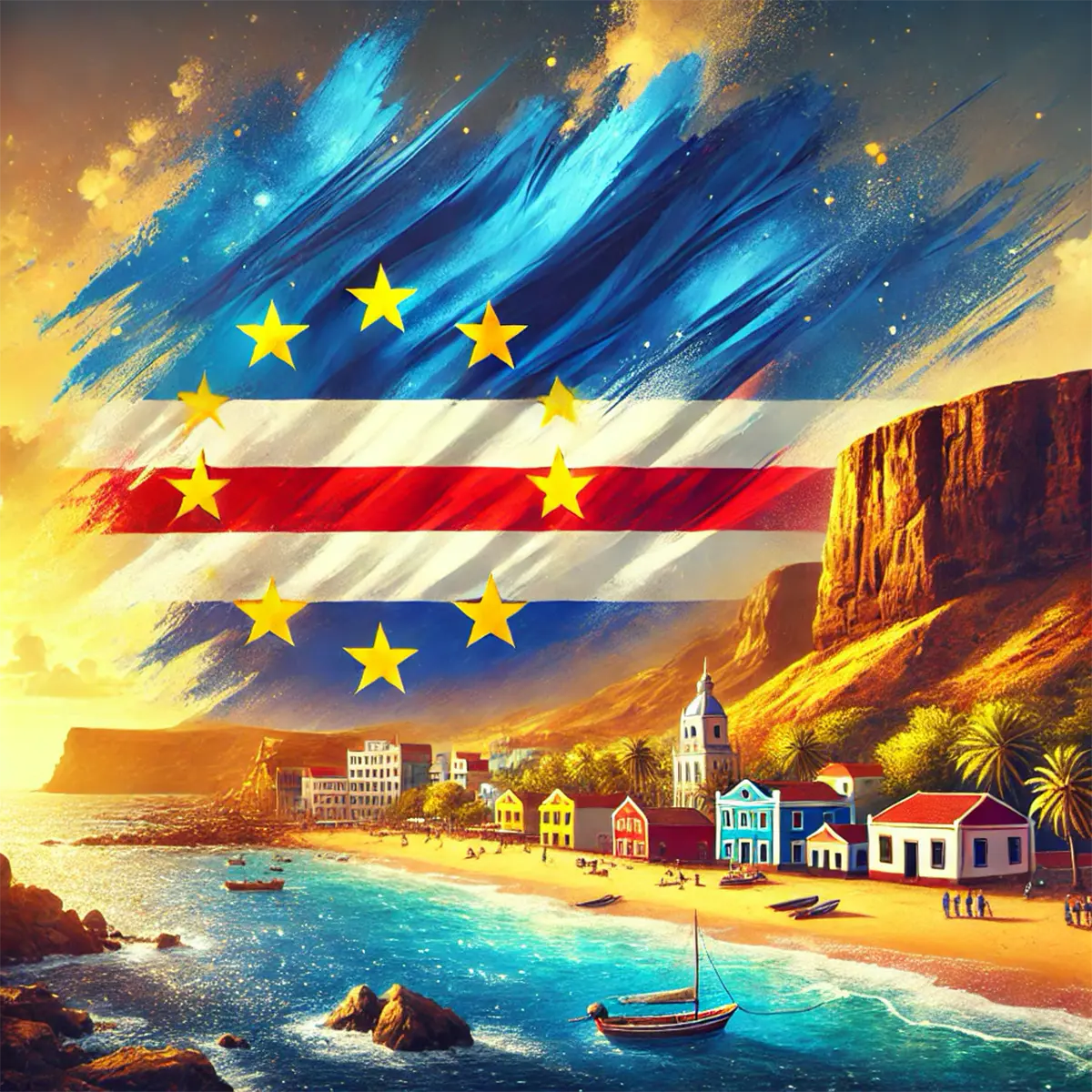
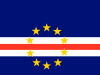
Democratic transition and the new flag (1990–1992). In 1990 Cape Verde abandoned the one-party system and held its first multi-party elections in January 1991, won by the opposition Movement for Democracy (MpD) led by Carlos Veiga. The new government moved quickly to redefine national symbols, distancing the country from its single-party past and the Pan-African iconography of the PAIGC era. After a public debate and a competition for new state symbols, the current flag was officially adopted on 22 September 1992, together with a new coat of arms and national anthem. The choice of blue, white and red, with ten stars instead of the African colour palette, was a deliberate statement: Cape Verde was reasserting its Atlantic, Creole and island identity rather than its purely continental African one.
The flag today. Since 1992 the design has not been altered. It flies over institutions in Praia, the capital on Santiago island, as well as over Cape Verdean communities abroad — the diaspora, particularly in the United States, Portugal, France and the Netherlands, is in fact larger than the resident population of the islands. The flag has become a unifying symbol of a small island nation that today is consistently ranked among the most stable democracies in Africa and a notable success story in development, tourism and cultural exports, from morna singer Cesária Évora to a growing global presence in music and football.