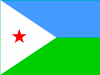
Flag of Djibouti

Flag of Djibouti

Official Colors

hex: #6AB2E7 rgb: 106, 178, 231
hex: #12AD2B rgb: 18, 173, 43
hex: #FFFFFF rgb: 255, 255, 255
hex: #D7141A rgb: 215, 20, 26

Country information

Continent Africa
Population 1,186,592 (2025)
Area 23,180 (2025)
Emoji 🇩🇯
Artistic representation Flag of Djibouti
Artistic representation "Flag of Djibouti"

The flag of the Republic of Djibouti was officially adopted on 27 June 1977, the very day the country declared independence from France. It consists of two equal horizontal bands — light blue on top and light green on the bottom — with a white isosceles triangle based on the hoist side and a red five-pointed star in the center of the triangle. The proportions are 21:38, one of the most unusual ratios among national flags in the world. The design is attributed to Mahamoud Harbi, a key figure of the anti-colonial movement who died in a plane crash in 1960 and never lived to see the flag he sketched raised over an independent nation.

Meaning of the Flag of Djibouti

Light blue stripe. Officially represents the Issa people — the Somali ethnic group that is one of the two largest in the country. Light blue is also the traditional color of Somali nations and echoes the flag of Somalia. In a broader reading, the stripe is associated with the sea — Djibouti sits on the strategic coast of the Gulf of Aden and the Bab-el-Mandeb Strait, through which a significant share of global maritime trade passes every day.

Light green stripe. Represents the Afar people, the second-largest ethnic group, who inhabit mostly the northern and western regions of the country. Green is also traditionally associated with Islam — the religion of roughly 94% of Djiboutians — and with the fertility of the land, which is striking given that most of Djibouti's territory is desert and semi-desert.

White triangle. Stands for peace and equality between the two main peoples of the country — the Issa and the Afar — whose historical coexistence has not always been peaceful. The triangle at the hoist also visually places the flag of Djibouti within a family of Arab and African flags (Sudan, Palestine, Western Sahara, UAE), although its color palette is unique.

Red five-pointed star. Symbolizes the unity of the country and the struggle for independence. The red color is traditionally interpreted as the blood shed by those who fought against colonial rule. In vexillology, the star on the Djiboutian flag is also read as a symbol of unity of all ethnic groups under a single national banner — besides the Issa and Afar, the country is home to Somali Issaq, Gadabuursi, Arab and European communities.

History of the Flag of Djibouti

Pre-colonial period. Before the arrival of Europeans, the territory of modern Djibouti was part of a complex network of sultanates and tribal federations. The north was dominated by Afar sultanates — Aussa, Tadjoura, Rahayto — while the south was the home of nomadic Issa Somali clans. The region had no single flag; instead, clan and sultanate banners were used, typically featuring Islamic symbolism such as the crescent and the shahada in Arabic script.

French Somaliland (1894–1967). The French arrived in 1862, when they purchased the port of Obock from the Afar sultan of Tadjoura. In 1894, the colony of French Somaliland (Côte française des Somalis) was officially proclaimed, with its capital in the newly founded city of Djibouti. Throughout the colonial period, the only official flag was the French tricolor. In 1958, after a referendum, the territory gained the status of an overseas territory of France; in 1967, after a second referendum, it was renamed the French Territory of the Afars and the Issas (Territoire français des Afars et des Issas, TFAI).

Flag of the TFAI (1967–1977). Between 1967 and 1977, the territory used its own flag: a white field with three vertical stripes near the fly — blue, green and red. This flag flew alongside the French tricolor and already contained the color palette that would partly carry over into the national symbol used today.

The independence struggle and Mahamoud Harbi. Mahamoud Harbi Farah (1921–1960) was a politician and trade-union leader who campaigned for independence from France during the 1958 referendum. After losing the vote and being accused of anti-government activity, he was forced into exile. He died on 29 September 1960 in a plane crash over Europe under unclear circumstances — many sources suggest a political assassination. The sketch of what later became the national flag is attributed to him. The struggle was carried on by movements such as the LPAI (Popular League for Independence) and the FLCS, which eventually forced Paris to call a third referendum.

Independence and adoption of the flag (1977). The referendum of 8 May 1977 returned an almost unanimous result — 98.8% in favor of independence. On 27 June 1977, at the official ceremony in the capital, the French tricolor was lowered and the national flag of Djibouti was raised for the first time. Hassan Gouled Aptidon, a leader of the Issa community, became the first president. The flag's colors — blue, green, white and red — codified the balance between the two main ethnic groups as a foundational principle of statehood. Since 1977, the flag has not been changed; the design has remained the same for more than 45 years.

Mini Quiz

Test your knowledge of flags

Congratulations!

You answered 0 out of 0 correctly.

Full Quiz