Pre-colonial period. The territory of modern Eritrea was historically part of various political units — including the Kingdom of Aksum (1st–7th centuries), the medieval Bahr Negash province of the Ethiopian Empire, and several coastal sultanates linked to the Red Sea trade. No single distinctive flag is associated with the region itself; rulers used Aksumite, Ethiopian or Ottoman-Egyptian banners depending on the era.
Italian colonial period (1890–1941). Italy formally established the Colonia Eritrea on 1 January 1890, naming it after the Greek term for the Red Sea. For the entire 51-year colonial period, the only official flag flown over Eritrea was the Italian tricolor — first the green-white-red flag of the Kingdom of Italy with the Savoy coat of arms, and from 1929 with the addition of fasci. Asmara became one of the most architecturally Italian cities outside Europe, and the colony was the launching pad for Mussolini's invasion of Ethiopia in 1935.
British military administration (1941–1952). After the Allied victory at the Battle of Keren in March 1941, Italian East Africa collapsed and Eritrea came under British military administration. During this decade the Union Jack flew over government buildings, while the fate of the territory was debated at the United Nations. There was no separate Eritrean flag.
Federation with Ethiopia and the first Eritrean flag (1952–1962). On 15 September 1952, under UN Resolution 390(V), Eritrea became an autonomous unit federated with the Ethiopian Empire. For the first time the territory received its own flag: a light blue field (often described as "UN blue") with a green olive wreath surrounding an upright olive branch in the center. The design was a clear nod to the United Nations flag, reflecting the body's role in establishing the federation. This emblem — the wreath and branch — is the direct ancestor of the symbol on today's flag.
Annexation by Ethiopia (1962–1991). On 14 November 1962, Emperor Haile Selassie dissolved the Eritrean parliament and unilaterally annexed Eritrea as Ethiopia's 14th province. The autonomous flag was abolished, and only the Ethiopian tricolor was permitted. This act triggered the Eritrean War of Independence, which had already begun in 1961 with the first shots fired by Hamid Idris Awate.
Liberation movements and the EPLF flag (1961–1991). Throughout the 30-year war, the Eritrean Liberation Front (ELF) and later the dominant Eritrean People's Liberation Front (EPLF) used their own banners. The EPLF flag — adopted in the 1970s — featured a red triangle along the hoist, a green field above and a blue field below, with a gold star in the red triangle. This is the direct visual prototype of the modern national flag: only the central emblem differs (star vs. wreath).
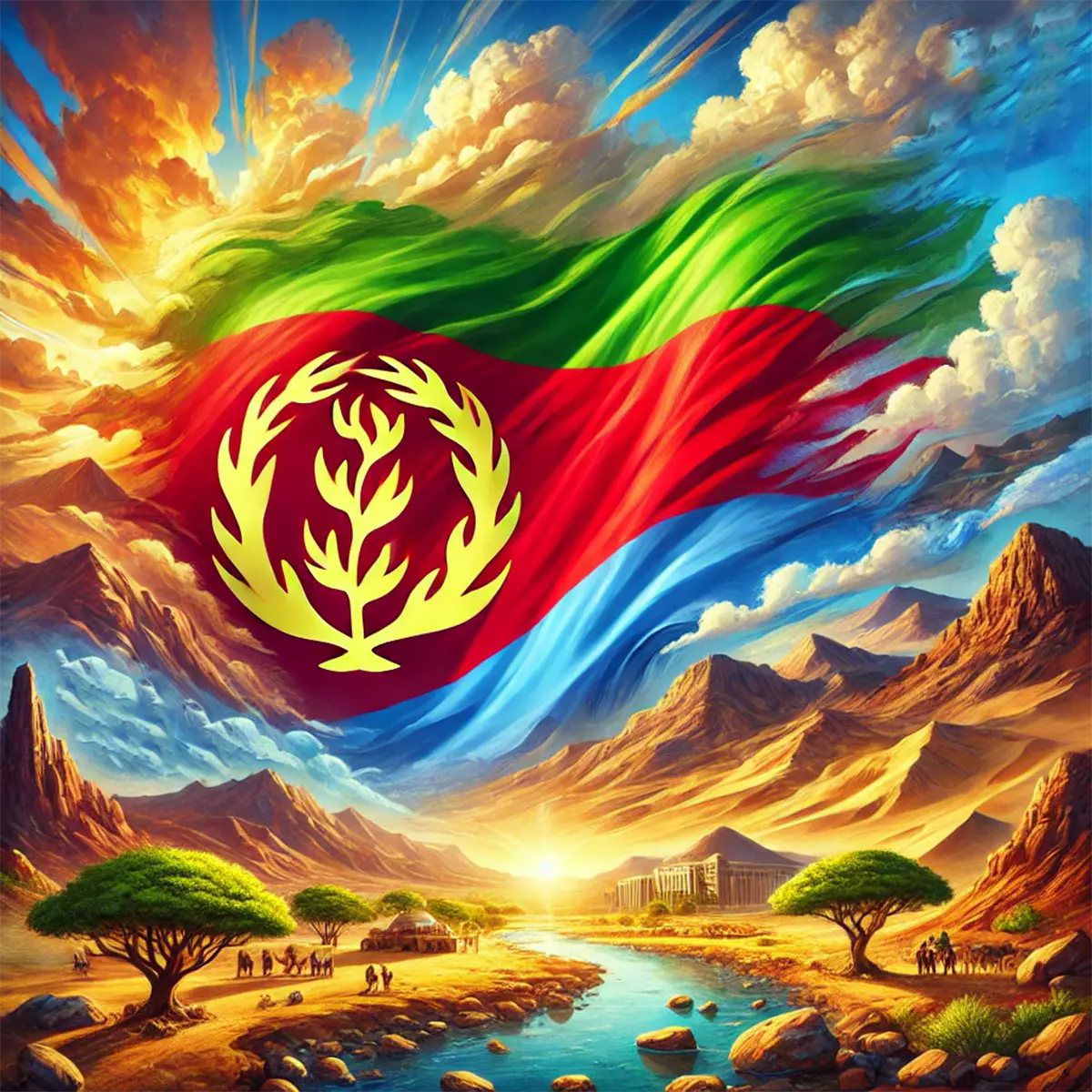
Independence and the modern flag (1991–1995). EPLF forces entered Asmara on 24 May 1991, ending the war. After a UN-supervised referendum in April 1993 in which 99.8% voted for independence, Eritrea was formally proclaimed an independent state on 24 May 1993. Initially, the EPLF flag with the gold star continued to serve as the national flag. On 5 December 1995, the National Assembly adopted the current design, replacing the star with the gold olive wreath and branch from the 1952 autonomous flag — symbolically merging the two key moments of Eritrean self-identification: the brief autonomy under the UN and the armed liberation under the EPLF.
Modern era. The flag has remained unchanged since 1995. It is flown on all government buildings, embassies abroad and during national holidays — most prominently on Independence Day (24 May), Martyrs' Day (20 June) and the Start of the Armed Struggle Day (1 September). Eritrea has no separate official Flag Day; the flag is symbolically central to Independence Day celebrations.