Pre-colonial period. Before the arrival of Europeans, the territory of modern Equatorial Guinea was home to the Bubi people on Bioko (then called Fernando Pó) and to the Fang, Ndowe, Bisio and other Bantu groups on the mainland. There was no single political entity covering the whole region, and therefore no common flag. Each ethnic group used its own clan or chiefdom symbols, mostly woven into ceremonial objects rather than fabric banners.
Portuguese and Spanish colonization (1474–1968). The Portuguese explorer Fernão do Pó reached the island that would later bear his name in 1472 (other sources say 1474). Portugal controlled the islands until 1778, when, under the Treaty of El Pardo, it ceded them to Spain in exchange for territories in South America. From that point on, the Spanish flag — in its various 18th, 19th and 20th-century forms — was the only official banner over the territory. The mainland of Río Muni was added to Spanish possessions only in 1900, after the Treaty of Paris settled the borders with French colonial holdings. Throughout the colonial period the territory was known as Spanish Guinea (Guinea Española).
Road to independence (1959–1968). In 1959 Spain reorganized the colony into two overseas provinces, granting its inhabitants formal Spanish citizenship. In 1963 the territory received internal autonomy and was renamed Equatorial Guinea. A constitutional referendum in 1968 paved the way for full sovereignty, and on 12 October 1968 the country declared independence under its first president, Francisco Macías Nguema. The flag adopted that day was almost identical to the modern one — green, white and red horizontal stripes with a blue triangle — but without any coat of arms in the center.
The Macías dictatorship and the altered flag (1973–1979). Macías quickly turned the country into one of the most brutal dictatorships of post-colonial Africa. Up to a third of the population either fled abroad or was killed during his rule. In 1973 he introduced a new constitution and a modified coat of arms placed on the flag: a rooster, a machete, a rifle and gardening tools — symbols meant to glorify labor and his personal cult — replaced the traditional emblem. The motto on the scroll was changed to "Unidad, Paz, Justicia", but the design itself reflected the regime's militarized rhetoric.
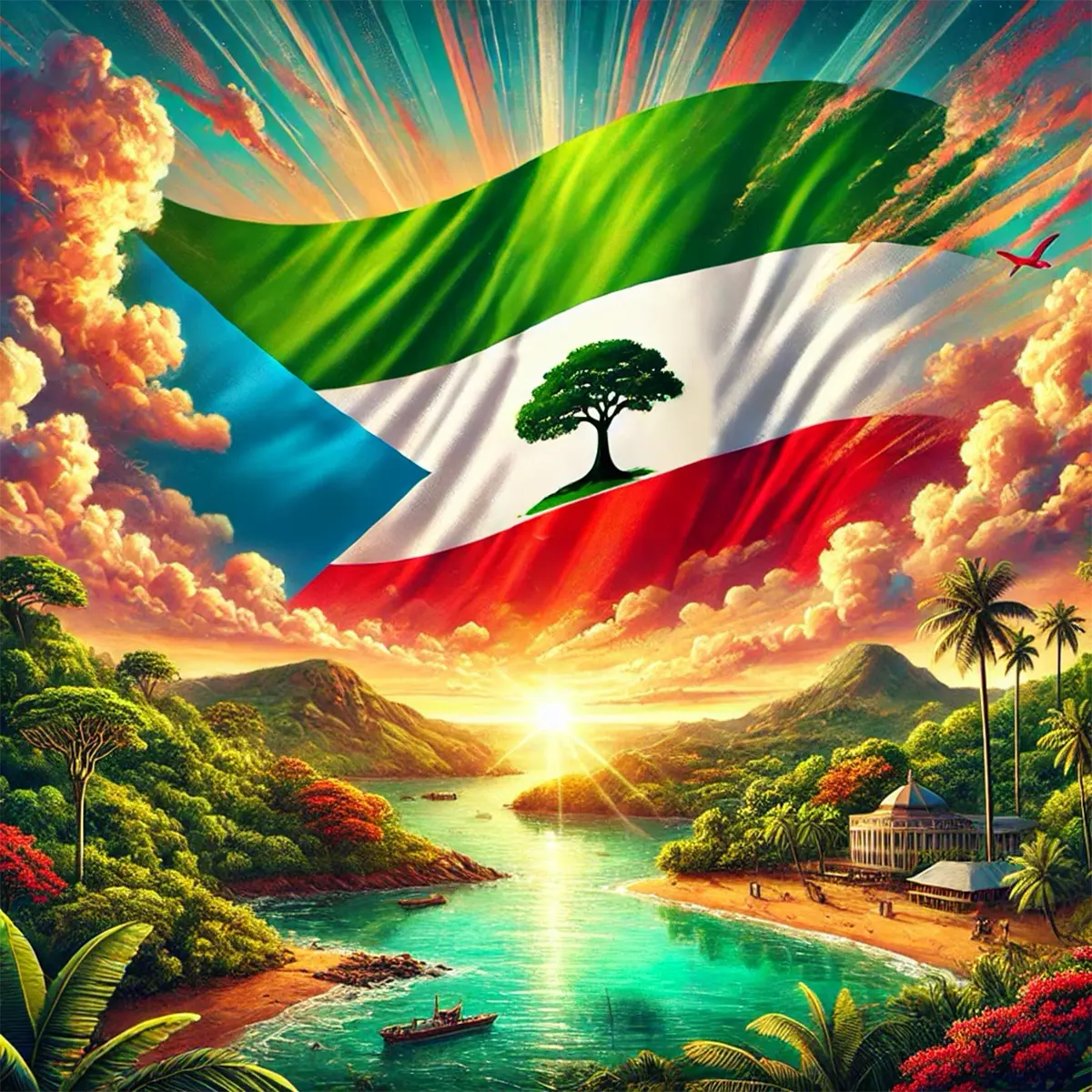
Coup of 1979 and restoration of the flag. On 3 August 1979, Macías was overthrown in a military coup led by his nephew Teodoro Obiang Nguema Mbasogo, who has remained in power ever since — making him the longest-serving non-royal head of state in the world. Macías was tried and executed in September of the same year. On 21 August 1979 the new government restored the original coat of arms with the silk-cotton tree, six stars and the motto "Unidad, Paz, Justicia", placing it in the center of the flag. This is the version that has been in use ever since.
Modern era. Since 1979 the flag has not been altered. It is flown on all government buildings, embassies and during national holidays — most prominently on Independence Day (12 October) and Freedom Day (3 August), which marks the coup against Macías. The civil version of the flag — without the coat of arms — is used by private citizens and on merchant vessels.