Flag of the Comoros

Artistic representation "Flag of the Comoros"
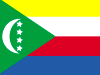
The flag of the Comoros is a layered symbol in which every color and every star refers to a specific island, while the green triangle, crescent and stars together affirm the country's Islamic identity. Unlike most national flags, here each element has a near-literal geographic reading.
Yellow stripe — represents the island of Mohéli (Mwali), the smallest of the four islands. In the Comorian symbolic tradition yellow is also associated with the warmth of the equatorial sun and with ylang-ylang, the flower for which the archipelago is world-famous as one of the leading producers of its essential oil.
White stripe — represents the island of Mayotte (Maore). Although Mayotte voted to remain French in 1974 and is today a French overseas department, the Comorian state continues to claim it constitutionally, and white preserves that symbolic link. White is traditionally read as a sign of peace and purity of intention.
Red stripe — represents the island of Anjouan (Ndzuani). Red also alludes to the sacrifices made on the path to independence and during the turbulent secessionist crises that shook Anjouan in the late 1990s, after which the federal structure of the country had to be rebuilt.
Blue stripe — represents the island of Grande Comore (Ngazidja), the largest island and home to the capital Moroni. Blue simultaneously evokes the Indian Ocean that surrounds and unites the archipelago.
Green triangle — the color of Islam, the religion of around 98% of Comorians and the state religion. Green is the dominant color in earlier Comorian flags as well, and the triangular form anchors the Islamic symbolism on the hoist side, where it is most visible.
White crescent — a classical symbol of Islam. Its horns open toward the fly, framing the row of four stars.
Four white five-pointed stars — once again refer to the four islands of the archipelago: Mwali, Maore, Ndzuani and Ngazidja. The repetition of "four" through both stripes and stars is deliberate: it doubles the message of national unity across the four traditional islands of the Comoros.
Pre-colonial sultanates and French protectorate
Before European contact, the Comoros archipelago was divided into a patchwork of small sultanates ruled by Shirazi and Arab dynasties, with strong cultural ties to the Swahili coast and the Arab world. No single national symbol existed; each sultanate used its own banners, often green with Islamic inscriptions. France gradually established control: it annexed Mayotte in 1841, declared a protectorate over the other islands in 1886, and in 1912 made the Comoros a full colony, administered from Madagascar until 1946.
First Comorian flag (1963)
In 1961 the Comoros gained internal autonomy within the French Republic, and in 1963 the territory adopted its first distinct flag: a plain green field with a white crescent in the center and four white stars arranged diagonally between its horns. Green stood for Islam, and the four stars already represented the four islands of the archipelago — a symbolic core that has survived every redesign since.
Independence and the flag of 1975–1978
On 6 July 1975, the Comoros unilaterally declared independence under Ahmed Abdallah, while Mayotte chose to remain French. The first flag of the independent state, used until 1978, kept the green field but rearranged the crescent (now tilted) and the four stars around it. Just weeks after independence, in August 1975, Ali Soilih overthrew Abdallah, opening one of the most unstable decades in the country's history.
The 1978, 1992 and 1996 redesigns
After Abdallah returned to power in 1978 with the help of French mercenary Bob Denard, a new flag was introduced — still green, with a white crescent in the lower hoist and four stars, and the name of the country and "Allahu Akbar" written in Arabic. In 1992, following the assassination of Abdallah and a return to multiparty politics, the inscriptions were removed and the layout simplified. A further revision in 1996 placed the crescent in the center and aligned the four stars vertically, foreshadowing the modern composition. Throughout all these versions, the four stars and the Islamic crescent remained constant.
Anjouan crisis and the 2002 constitution
In 1997 the islands of Anjouan and Mohéli attempted to secede, demanding a return to French rule. The crisis was resolved only through a long mediation by the African Union and a new federal framework: the 2001 constitution transformed the country into the Union of the Comoros, granting each island its own president, government and flag. As part of this national reconciliation, on 7 January 2002, a completely new national flag was adopted — the current four-striped design with the green triangle, crescent and four stars. For the first time, each island received its own dedicated color on the federal flag, while the Islamic symbolism was preserved in the hoist triangle.
Modern period
The 2002 flag has remained unchanged through the constitutional reforms of 2009 and 2018 and the political shifts under presidents Ahmed Abdallah Sambi, Ikililou Dhoinine and Azali Assoumani. It is enshrined as a state symbol alongside the coat of arms, the national anthem Udzima wa ya Masiwa ("The Unity of the Great Islands") and the official motto "Unité – Solidarité – Développement". The flag is flown over the Beit-Salam presidential palace in Moroni and is used by all three island governments alongside their own island flags.