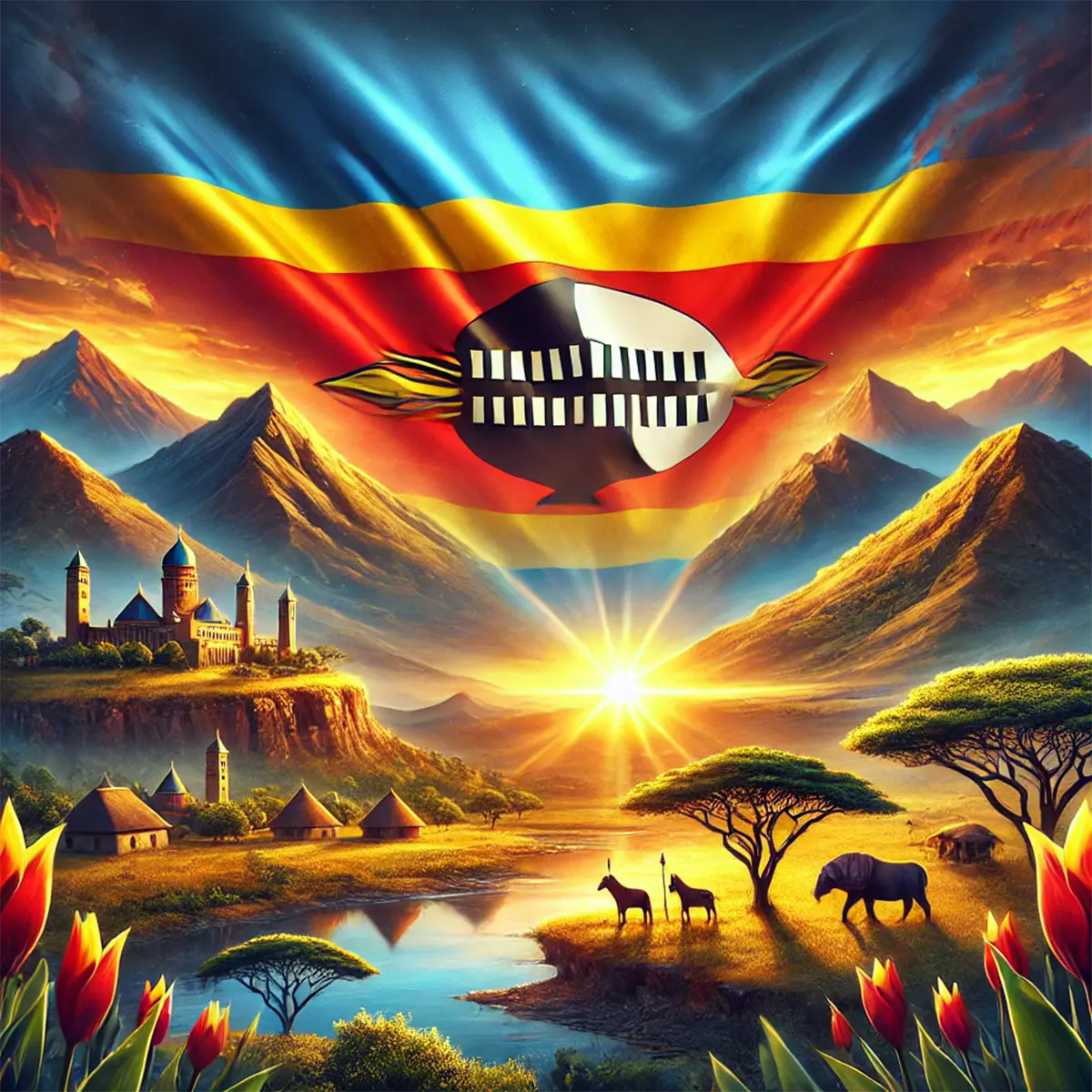
Flag of Eswatini

Flag of Eswatini

Official Colors

hex: #3E5EB9 rgb: 62, 94, 185
hex: #FFD900 rgb: 255, 217, 0
hex: #B10C0C rgb: 177, 12, 12
hex: #FFFFFF rgb: 255, 255, 255
hex: #000000 rgb: 0, 0, 0

Country information

Continent Africa
Population 1,254,388 (2025)
Area 17,200 (2025)
Emoji 🇸🇿
Artistic representation Flag of Eswatini
Artistic representation "Flag of Eswatini"

The national flag of Eswatini was officially adopted on 6 October 1968, just one day before the country gained independence from the United Kingdom on 6 September 1968 — wait, the official adoption is recorded on 6 October 1968, while independence had been proclaimed on 6 September of that same year, with the flag's design having been finalised slightly earlier in 1967. It has a 2:3 ratio and consists of five horizontal stripes: blue at the top and bottom, thin yellow stripes separating them from a broad central red band. The most striking element sits in the middle of the red stripe — a large black-and-white Nguni ox-hide war shield placed horizontally, with two assegai spears and a ceremonial staff (umgobho) decorated with tufts of widowbird and lourie feathers. Eswatini is one of the very few countries in the world whose flag depicts an actual weapon, and the design is taken almost directly from the battle standard of the Emasotsha royal regiment, presented by King Sobhuza II in 1941. When the country was officially renamed from "Swaziland" to "Eswatini" in 2018, the flag itself remained unchanged.

Meaning of the Flag of Eswatini

Blue stripes (top and bottom). Officially symbolise peace and stability — values that the Swazi monarchy has long projected as a defining feature of the nation, especially in contrast with the turbulent decolonisation of neighbouring Southern African states. Blue has been present on Swazi flag designs ever since the 1941 Emasotsha regimental banner.

Yellow stripes. The two narrow golden bands separating blue from red represent the country's mineral wealth and natural resources. Historically Swaziland was a notable producer of asbestos (the Havelock mine near Bulembu was once one of the largest in the world), iron ore (Ngwenya), coal and tin — and these resources played a key role in the colonial-era economy.

Red stripe. The broadest band in the centre represents past battles fought by the Swazi nation — both during the 19th-century Nguni migrations under kings Sobhuza I and Mswati II, and later clashes with Boer and British forces over land and sovereignty. It is read as the colour of blood shed in defence of the people.

Nguni shield. Placed horizontally on the red stripe — unlike the vertical shields of many other African flags such as Kenya's — the black-and-white oxhide war shield carries a specific reading. According to the most widely cited interpretation, the alternating black and white colours symbolise the peaceful coexistence of Black and white peoples within the country. Shields of this exact pattern were historically issued to the Emasotsha regiment.

Two spears. Lying behind the shield in parallel, the assegais represent the defence of the nation against its enemies — both external and internal. In Swazi culture the spear is more than a weapon: it remains an attribute of male dignity and warrior status, prominently displayed during the annual Incwala ceremony.

Staff with feather tassels (umgobho). The ceremonial fighting staff decorated with two feather tufts is the most politically loaded element. The blue tassel is made of feathers from the long-tailed widowbird (sakabuli), worn by ordinary warriors, while the red tassel is made of feathers from the purple-crested turaco — known locally as ligwalagwala — which by Swazi law may be worn only by the king (Ngwenyama) and the queen mother (Ndlovukati). The staff therefore stands for royal authority and the unbreakable link between the monarchy and the people.

History of the Flag of Eswatini

Pre-colonial period. The Swazi nation crystallised as a distinct political unit in the 18th century under the Dlamini dynasty. King Mswati II (reigning from around 1840 and the eventual eponym of the modern country's name) substantially expanded the kingdom and reorganised the army along regimental lines — the emabutfo system that would later give rise to the Emasotsha regiment. No national flag in the modern sense existed at this time, but individual regiments carried their own shield patterns and identifying markings into battle.

Boer and Transvaal influence (1894–1902). In 1894, following a series of conventions, Swaziland was placed under the administration of the South African Republic (Transvaal) of Paul Kruger. The Transvaal Vierkleur flag was the de facto official banner over Swazi territory during this short period, even though the Swazi monarchy retained internal authority. The arrangement ended with the British victory in the Second Anglo-Boer War in 1902.

British protectorate (1903–1968). From 1903 Swaziland was administered as a British High Commission Territory, initially through the Transvaal and from 1906 directly via the High Commissioner for South Africa. Throughout the 65-year colonial period there was no separate Swazi national flag — the Union Jack flew over administrative buildings. The Swazi monarchy, however, was never abolished: King Sobhuza II, who ascended the throne in 1921, gradually rebuilt traditional institutions, including the regimental system.

The Emasotsha regimental banner (1941). In 1941, when a Swazi contingent was formed to fight alongside Allied forces in the Second World War, King Sobhuza II presented the Emasotsha (literally "the soldiers") regiment with a special battle standard. It already carried the basic composition of today's national flag: blue, yellow and red horizontal fields with a black-and-white Nguni shield, spears and a feathered staff at the centre. Swazi soldiers served with British forces in North Africa, the Middle East and Italy. After their return, the banner gradually acquired a status well beyond its original military function.

Path to independence and adoption of the flag (1967–1968). On 25 April 1967 Swaziland was granted internal self-government as a Protected State, and the Swazi authorities began work on the formal symbols of the coming sovereign state. The flag was developed directly from the Emasotsha standard of 1941, with the stripes restandardised and the central emblem precisely defined. The design was approved by King Sobhuza II personally — he insisted that every element of the regimental banner be preserved, as a tribute to the veterans and as a marker of monarchical continuity. The flag was officially adopted on 6 October 1968, one month after independence was proclaimed on 6 September 1968, although several sources also list 30 October 1967 as the date the design was originally registered for the self-governing state — the discrepancy reflects the two-stage adoption (self-government then full independence).

Modern era and renaming of the country (1968 – today). The flag has not been changed since adoption. On 19 April 2018, marking the 50th anniversary of independence and his own 50th birthday, King Mswati III announced that the country would henceforth be known as the Kingdom of Eswatini — meaning "Land of the Swazi" in siSwati — rather than Swaziland. The change was formally registered with the United Nations in August 2018. The flag's design, colours and proportions were left entirely untouched. Today it flies over all government buildings, embassies abroad and at the two key national occasions — Independence Day (Somhlolo Day) on 6 September and the Incwala royal ceremony at the turn of the year.
Mini Quiz

Test your knowledge of flags

Congratulations!

You answered 0 out of 0 correctly.

Full Quiz