Pre-colonial era. Long before European arrival, the territory of modern Burkina Faso was home to powerful Mossi kingdoms — most notably Ouagadougou, Yatenga, Tenkodogo and Fada N'Gourma — which emerged around the 11th–15th centuries. These states did not use flags in the European sense; royal authority was expressed through the institution of the Mogho Naaba (emperor of the Mossi), through court regalia, drums and ceremonial spears. Alongside the Mossi lived the Gurunsi, Bobo, Lobi, Senufo, Fulani and Tuareg peoples, each with their own political symbols.
French colonization (1896–1958). French forces conquered the Mossi capital Ouagadougou in 1896, and the territory was gradually absorbed into French West Africa. In 1919 the colony of Upper Volta (Haute-Volta) was created, named after the three rivers — the Black, White and Red Volta — that cross the country. In 1932 the colony was dissolved and partitioned between Côte d'Ivoire, French Sudan (today Mali) and Niger, before being reconstituted in 1947 after intense lobbying by Mossi chiefs led by the Mogho Naaba. Throughout this period the territory was represented exclusively by the French tricolour.
Republic of Upper Volta and the first flag (1958–1984). On 11 December 1958 Upper Volta became an autonomous republic within the French Community, and on 5 August 1960 it gained full independence under President Maurice Yaméogo. The first national flag, adopted in 1959, was a horizontal tricolour of black, white and red — colours directly referencing the three Volta rivers (Black Volta, White Volta and Red Volta). This flag flew over Upper Volta for almost 25 turbulent years, marked by several coups d'état: Yaméogo was overthrown by Sangoulé Lamizana in 1966, who was in turn deposed by Saye Zerbo in 1980, followed by Jean-Baptiste Ouédraogo in 1982.
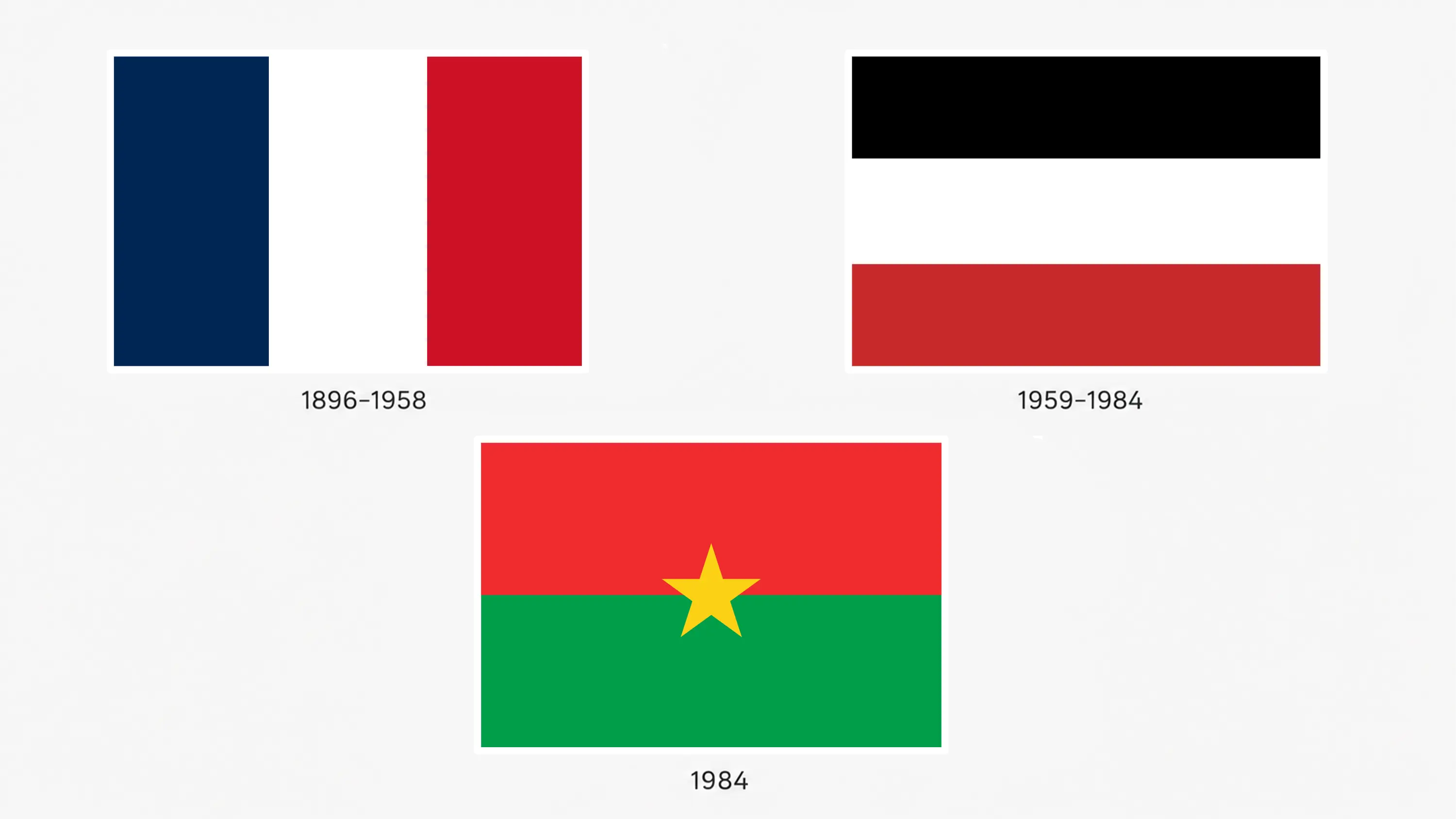
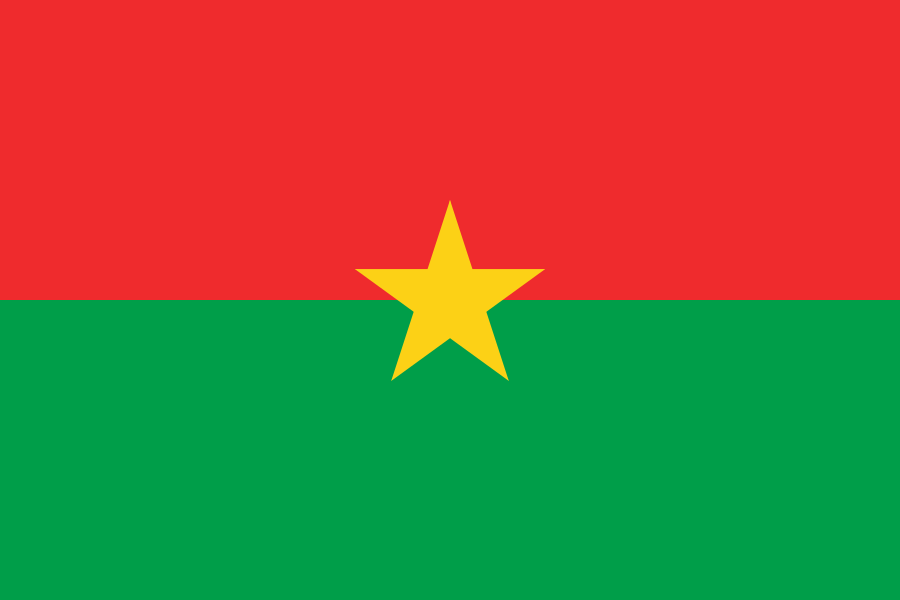
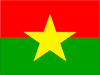
The Sankara revolution and the new flag (1983–1984). On 4 August 1983, a group of young left-wing officers led by Captain Thomas Sankara seized power and proclaimed the National Council of the Revolution (CNR). Sankara, then 33, launched one of the most radical transformation programmes in African history — mass vaccination campaigns, large-scale tree planting against desertification, women's rights reforms, and a sweeping cultural rebranding of the state. On 4 August 1984, the first anniversary of the revolution, the country was officially renamed from Upper Volta to Burkina Faso — a hybrid name combining Mooré (burkina — "upright, honest") and Dyula (faso — "homeland"), meaning "the land of upright people". On the very same day, the old black-white-red flag was replaced by the current red-green design with the yellow star, and a new national anthem, "Ditanyè" (also called "Une seule nuit"), was adopted.
After Sankara (1987–present). Thomas Sankara was assassinated on 15 October 1987 in a coup led by his comrade-in-arms Blaise Compaoré, who would rule the country for the next 27 years until being ousted by a popular uprising in October 2014. Despite the dramatic political reversal — Compaoré dismantled most of Sankara's policies — the flag, the name of the country and the anthem were all retained, a testament to how deeply the 1984 symbols had become rooted in national identity. Since 2022 Burkina Faso has experienced two further military coups, bringing Captain Ibrahim Traoré to power; he has openly invoked Sankara's legacy, and the 1984 flag remains its central visual emblem.