Pre-colonial period and German Kamerun (until 1916). Before the arrival of Europeans, the territory of modern Cameroon was home to dozens of ethnic groups and traditional kingdoms — Bamum, Bamileke, Fulani and others — each with its own dynastic symbols. In 1884 the German Empire proclaimed the protectorate of Kamerun after signing a treaty with local rulers in Douala. The imperial German flag — a black-white-red horizontal tricolor — was used over these lands. No separate colonial flag with Cameroonian heraldry was ever officially adopted, although a draft featuring an elephant was under development in 1914 but never took effect due to the outbreak of World War I.
French and British mandates (1916–1960). After Germany's defeat in World War I, Cameroon was divided in 1916 between France and Britain. Under the League of Nations mandate and later UN trusteeship, about 80% of the territory went to France (Cameroun français), while the remainder went to Britain, which administered its share as Northern and Southern Cameroons alongside neighboring Nigeria. During this period, the French tricolor flew over the French zone, while the Union Jack and the flags of the Nigerian colonial administration flew over the British zones.
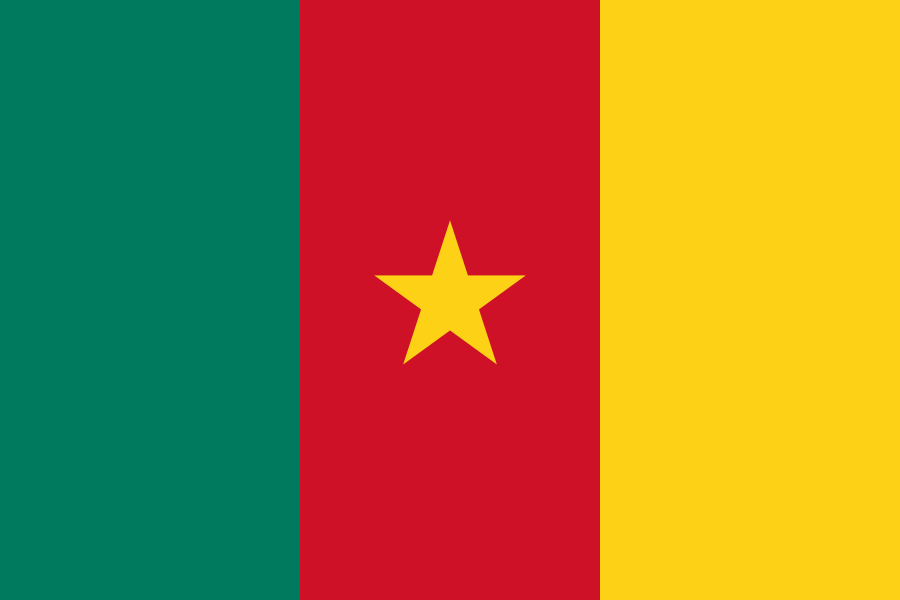
Autonomy and the first national flag (1957). On 29 October 1957, French Cameroon gained internal self-government and adopted its first national flag — a vertical tricolor of green, red and yellow with no additional symbols. The design was proposed by the first Prime Minister, André-Marie Mbida, together with the Assembly. The choice of Pan-African colors was a political statement, aligning the young nation with the broader African liberation movement.
Independence of the Republic of Cameroon (1960). On 1 January 1960 French Cameroon became independent as the Republic of Cameroon, led by President Ahmadou Ahidjo. The 1957 flag was retained unchanged. It was one of the few cases in African history where a flag from the autonomy period passed unmodified into use as the flag of an independent state.
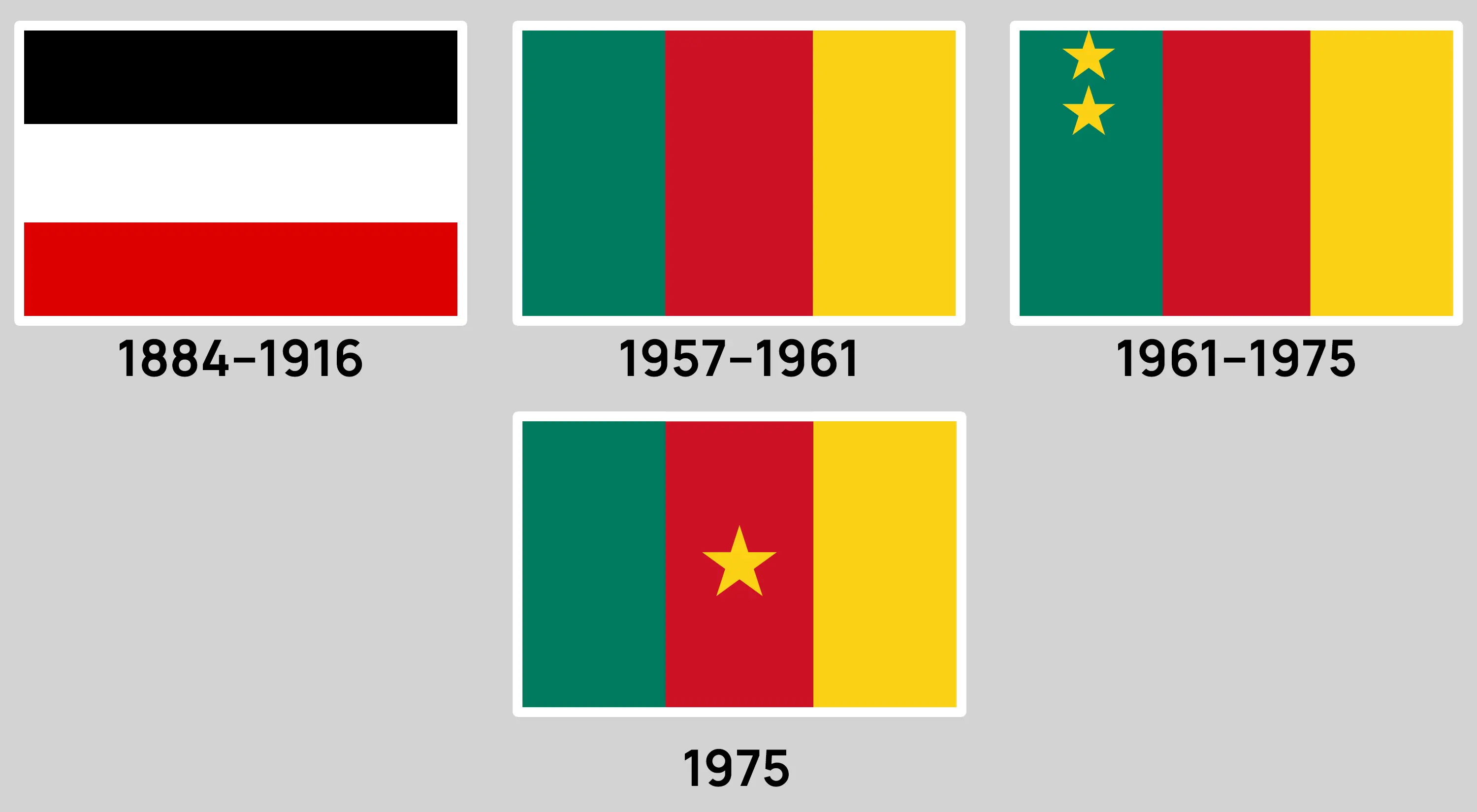
Federal Republic of Cameroon (1961–1975). On 1 October 1961, following a referendum in British Southern Cameroons, that territory joined the Republic of Cameroon to form the Federal Republic of Cameroon. Northern Cameroons instead chose to merge with Nigeria. Two yellow five-pointed stars were added to the upper hoist corner of the green stripe, representing the two states of the federation: East Cameroon (former French) and West Cameroon (former British Southern). This was the only period in the country's history when the flag bore more than one symbol.
United Republic and the modern flag (1975). On 20 May 1972, President Ahidjo held a referendum that abolished the federal structure, turning the country into a unitary United Republic of Cameroon. On 20 May 1975, the new flag was officially adopted: the two stars on the green stripe were replaced by a single large star at the center of the red stripe, which since then has symbolized national unity. The basic tricolor layout remained unchanged. In 1984, President Paul Biya renamed the country simply the Republic of Cameroon, but the flag was kept as it was.
Today. The flag of Cameroon has not changed since 1975. 20 May — the date the unitary state was proclaimed — became a national holiday on which the flag plays a central role. The day is often mistakenly referred to as Independence Day, even though actual independence was gained on 1 January 1960.