Pre-colonial era. Before European contact, the territory of modern Botswana was inhabited mainly by Tswana-speaking peoples organized into several chiefdoms — the Bangwato, Bakwena, Bangwaketse and others. These polities did not use flags in the European sense; political authority was expressed through the institution of the kgosi (chief), through cattle wealth and through the kgotla, the traditional public assembly.
Bechuanaland Protectorate (1885–1966). In 1885, fearing expansion by Boer settlers from the Transvaal and by Cecil Rhodes's British South Africa Company, several Tswana chiefs — most famously Khama III of the Bangwato — appealed to the British Crown for protection. The territory was declared the Bechuanaland Protectorate, administered separately from the Cape Colony and, importantly, never incorporated into South Africa. Throughout this period the territory had no flag of its own and was represented by the British Union Jack. A distinctive feature of Bechuanaland was that the protectorate's administrative capital was located outside its borders, in Mafeking (now Mahikeng) in South Africa, until 1965.
Road to independence (1965–1966). In 1965 internal self-government was granted, the capital was moved to the newly built town of Gaborone, and Seretse Khama — heir to the Bangwato chieftainship and founder of the Bechuanaland Democratic Party — became Prime Minister. As independence approached, the government deliberately rejected several proposed flags based on the Pan-African colors. The chosen design was meant to underline that the new state would be defined not by ethnic or racial categories but by shared citizenship and by the central role of water in national life.
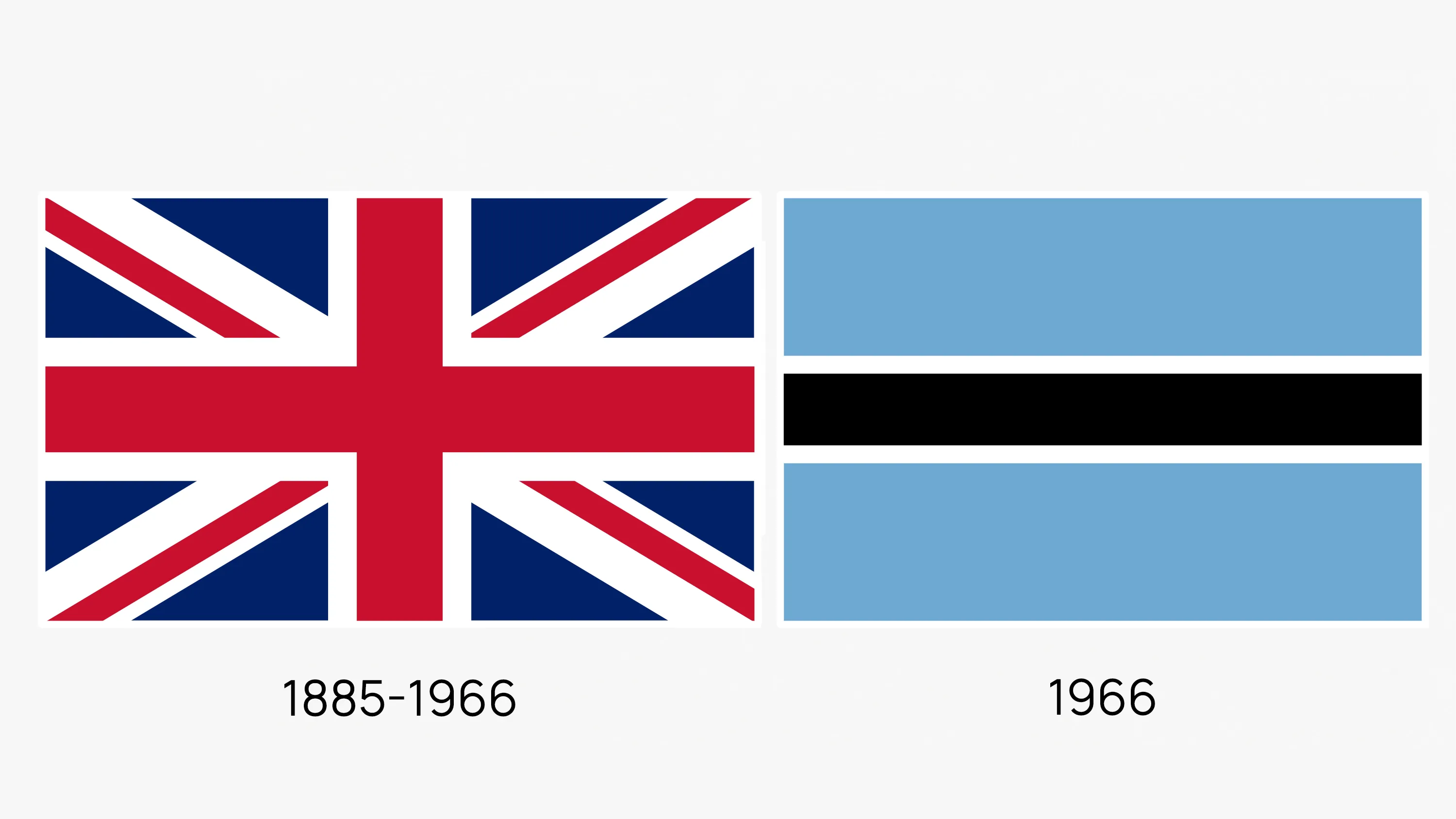
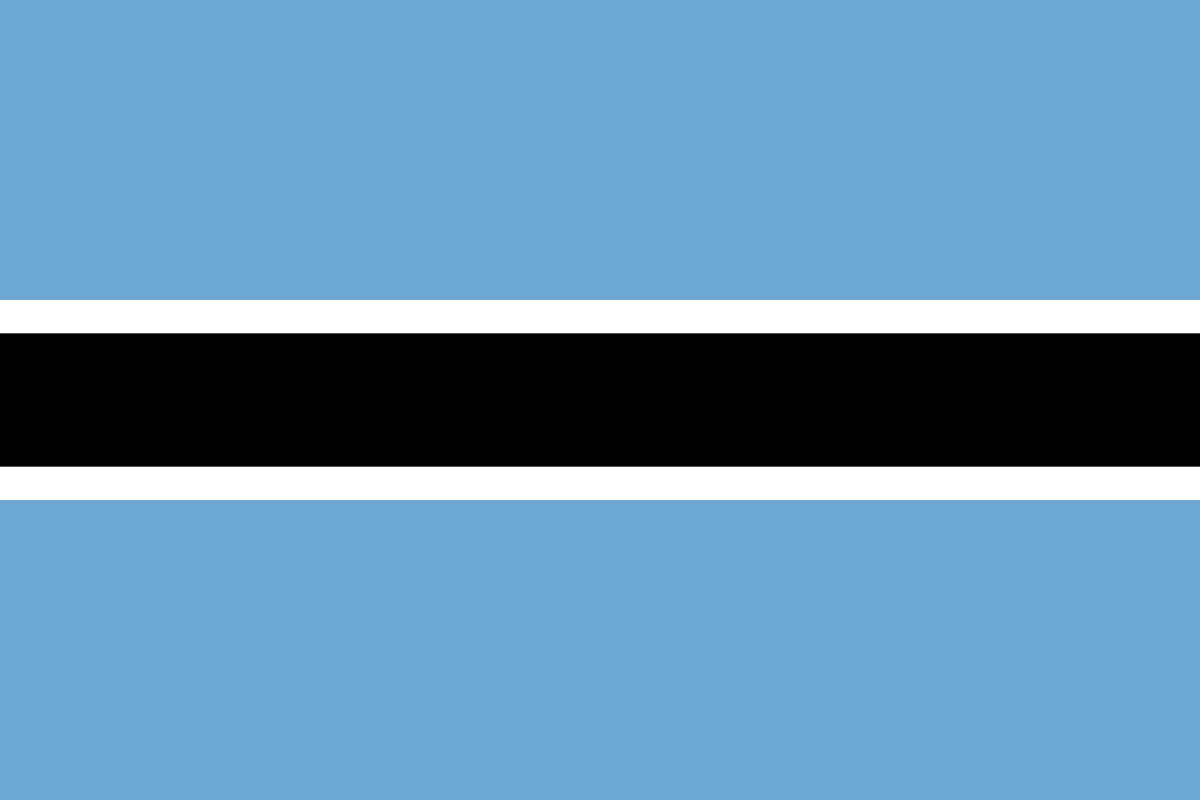
Independence and adoption of the flag (1966). On 30 September 1966, the Bechuanaland Protectorate became the independent Republic of Botswana, with Seretse Khama as its first President. At midnight on that date the Union Jack was lowered in Gaborone and the new blue-black-white flag was raised for the first time. The design has remained completely unchanged ever since — a rarity in post-colonial Africa, where many states have revised their flags at least once.
Current status. Botswana's flag is one of the most stable national symbols on the continent. Its use is regulated by national legislation on state symbols, and it flies alongside the country's coat of arms (featuring two zebras and the motto "Pula") and the national anthem "Fatshe leno la rona" ("Our Land"). The flag is widely seen at sporting events — particularly during appearances of the national football team, the "Zebras", whose nickname directly references the same black-and-white symbolism.