Pre-colonial period. Long before the arrival of Europeans, the territory of modern Ghana was home to powerful states — the Ashanti (Asante) Empire, the kingdoms of Dagbon and Mamprusi, and the Fante coastal states. Among the Ashanti, the central symbol of unity was not a flag in the European sense, but the Golden Stool (Sika Dwa Kofi) — a sacred object believed to embody the soul of the Ashanti nation. The visual culture of the region was built around Adinkra symbols, kente cloth, the colorful umbrellas of chiefs, royal drums and other ceremonial regalia. In other words, the area had a rich symbolic tradition long before colonization, but not a single "national flag" in the modern state sense.
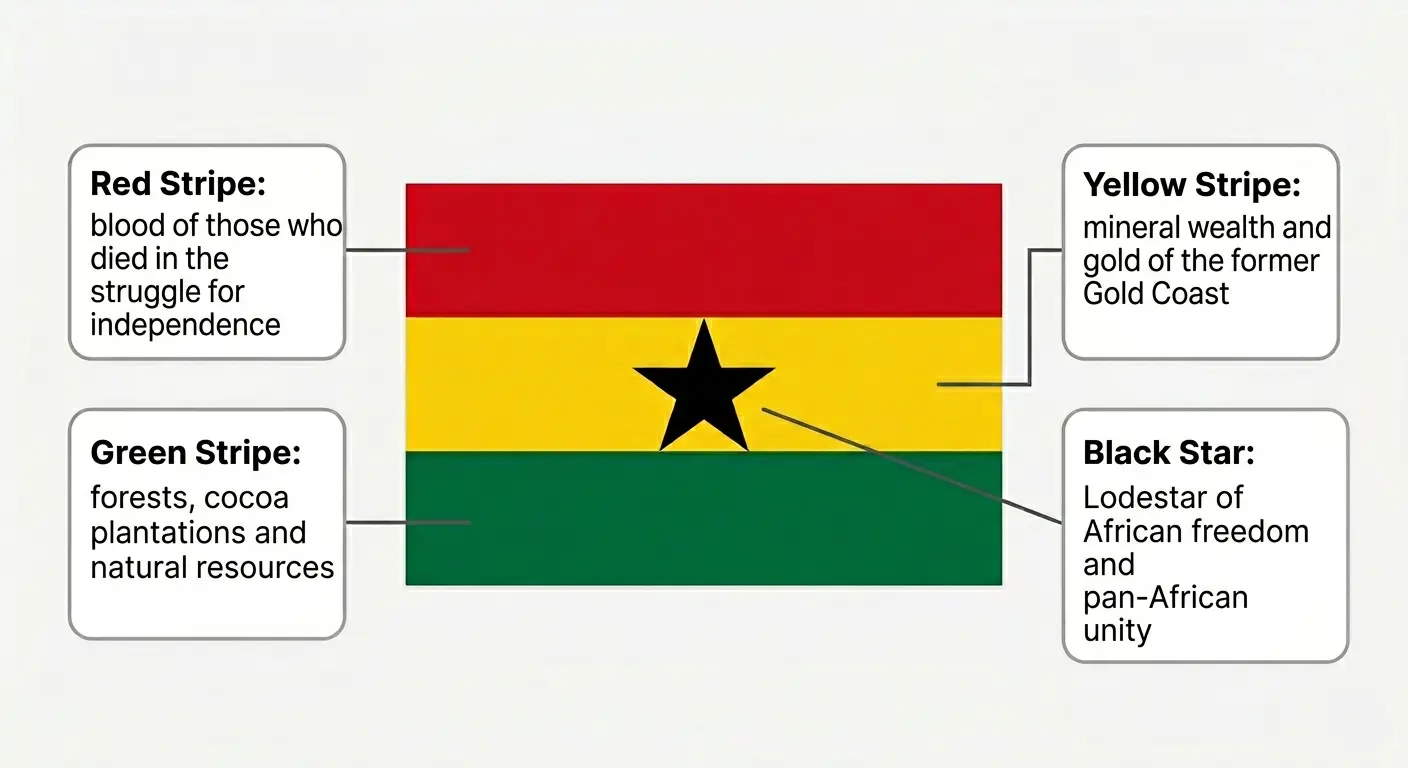
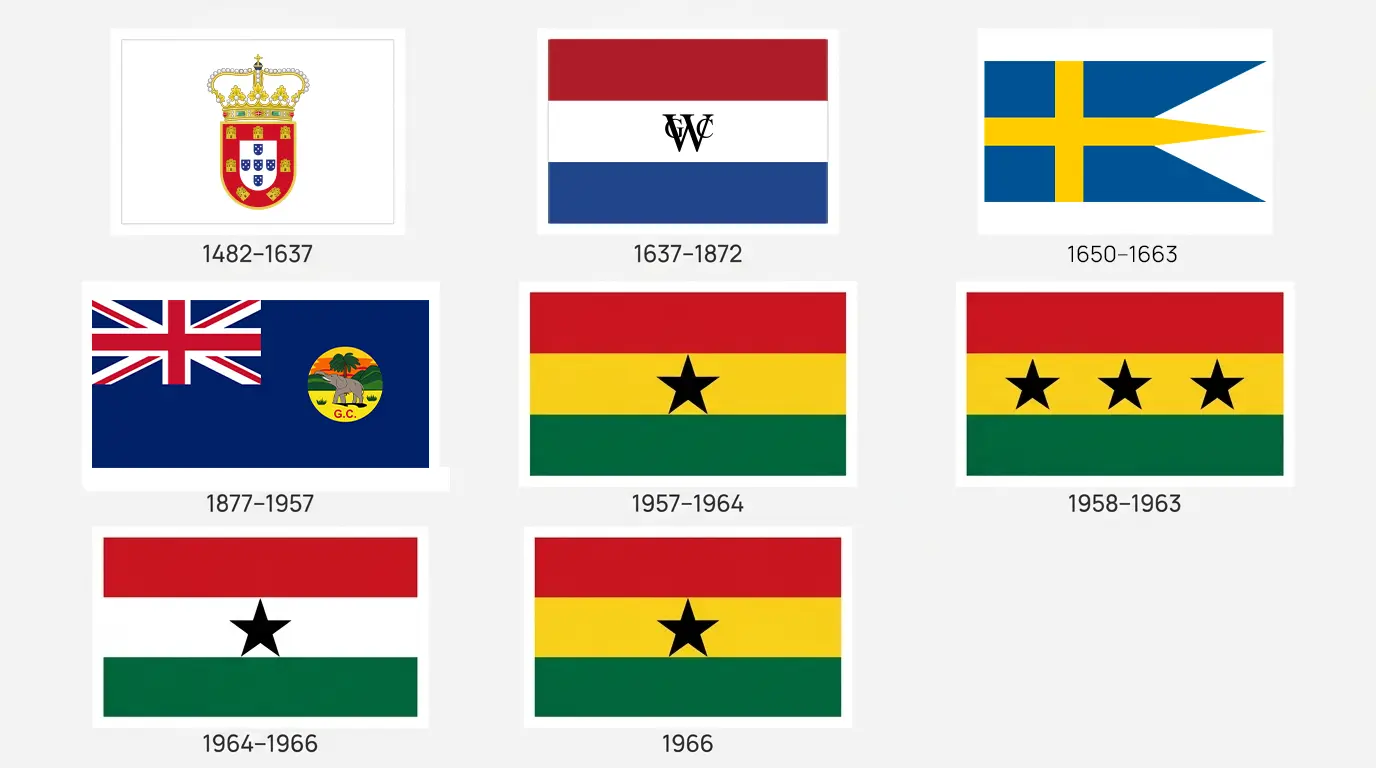
European flags on the Gold Coast. The first Europeans to establish a foothold on the coast of modern Ghana were the Portuguese, who built the fort of São Jorge da Mina — today known as Elmina — in 1482. Over the following centuries, the coastline was dominated in turn by the flags of Portugal, the Dutch West India Company, Denmark, Brandenburg-Prussia and Great Britain. This was not a single colonial space, but rather a chain of forts and trading posts where different European powers competed for gold, ivory and, tragically, slaves. The very name "Gold Coast" took root because of the scale of gold trading — a motif that would later pass directly into the yellow stripe of the Ghanaian flag.
British Gold Coast (1821–1957). In 1821 the British Crown took direct control of the coastal forts on the Gold Coast, and in 1874 the territory was formally proclaimed the Gold Coast Colony. After a series of Anglo-Ashanti Wars, Britain gradually extended its power inland: in 1901, Ashanti and the Northern Territories became British protectorates. The colony flew the British Blue Ensign with a colonial badge — a shield depicting an elephant, a palm tree and mountains — a typical pattern for the British Empire: the Union Jack in the canton and a local emblem on the blue field. This flag remained in use until 1957, while the administrative shape of the territory kept evolving into what would become the state of Ghana.
British Togoland and the shaping of modern Ghana. A separate but important chapter was British Togoland — the western portion of the former German colony of Togo, placed under British mandate after World War I and later turned into a UN trust territory. In 1956 a plebiscite was held there, and the majority of voters chose to join the Gold Coast. As a result, independent Ghana in 1957 emerged not simply as a former Gold Coast Colony, but as a new state that united the Gold Coast, Ashanti, the Northern Territories and British Togoland. The new flag therefore had to represent not a colonial administration, but the shared political identity of this unified country.
The road to independence. After World War II the anti-colonial movement gathered rapid momentum. A key moment came on 28 February 1948, when British colonial police opened fire on a group of war veterans in Accra who were marching to demand their promised benefits and employment. Their deaths triggered widespread riots and the arrest of UGCC leaders, among them Kwame Nkrumah. In 1949 Nkrumah founded the Convention People's Party (CPP) under the slogan "Self-Government Now". The "Positive Action" campaign of civil disobedience in 1950, the CPP's victories in the elections of 1951, 1954 and 1956, and sustained pressure from a mass movement made independence inevitable.
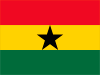
The birth of the flag in 1957. On the eve of independence a public competition was held to design a new national flag. The winner was Theodosia Salome Okoh (1917–2015) — an art teacher, painter and later a major figure in Ghanaian sport. Her design of a red, yellow and green tricolor with a black star at the center was officially approved. At midnight on 6 March 1957, on the Polo Ground in Accra, the British flag was lowered and the flag of Ghana was raised for the first time. At that same moment Kwame Nkrumah delivered his famous declaration: "Ghana, your beloved country, is free forever." Ghana became the first country in Sub-Saharan Africa to gain independence from a European power, and its flag instantly became a symbol not just of a single state, but of the entire African liberation movement.
Why the black star. The central star was no decorative afterthought. It referred to the idea of the "Black Star of Africa" — a symbol of the liberation of people of African descent and the future unity of the continent. It is most often linked to Marcus Garvey's Black Star Line, the shipping company founded in 1919 as part of a broader pan-African movement. For Nkrumah, who thought not only in Ghanaian but in continental terms, the star was the perfect emblem: simple, powerful and instantly understandable without explanation.
The Republic of 1960. On 1 July 1960 Ghana became a republic, with Kwame Nkrumah as its first president. The flag itself was left unchanged: the red-yellow-green tricolor with the black star had already become the central symbol of independence. This is a telling detail — many newly independent states redesigned their symbols when they declared a republic, but Ghana chose to keep the 1957 design as the visual foundation of its new statehood.
The Union of African States and a flag with multiple stars. In 1958 Ghana and Guinea formed the Union of African States, an early experiment in political integration between independent African countries. The Union used a flag based directly on the Ghanaian design, but with two black stars — one for each member state. When Mali joined in 1961, a third star was added. This was not Ghana's domestic state flag, but the episode is highly revealing: the Ghanaian flag effectively became the template for the symbolism of the pan-African union that Nkrumah dreamed of building.
The redesign of 1964–1966. In 1964, after Ghana was turned into a one-party state under the CPP, the central yellow stripe was replaced by a white one. The new flag consisted of red, white and green stripes with a black star at the center. The change was openly political: white matched the party colors of the Convention People's Party. This version did not last long. On 24 February 1966, while Nkrumah was on a state visit abroad, the army and police staged a coup, and power passed to the National Liberation Council (NLC).
The restoration of the 1957 flag. After the coup the new authorities discarded the party-colored version and brought back the original design by Theodosia Okoh. From 28 February 1966 onward, the red, yellow and green tricolor with the black star has once again served as the state flag of Ghana. This version has survived multiple military regimes, several successive republics, deep economic crises, the return to multi-party democracy and the adoption of the 1992 Constitution.
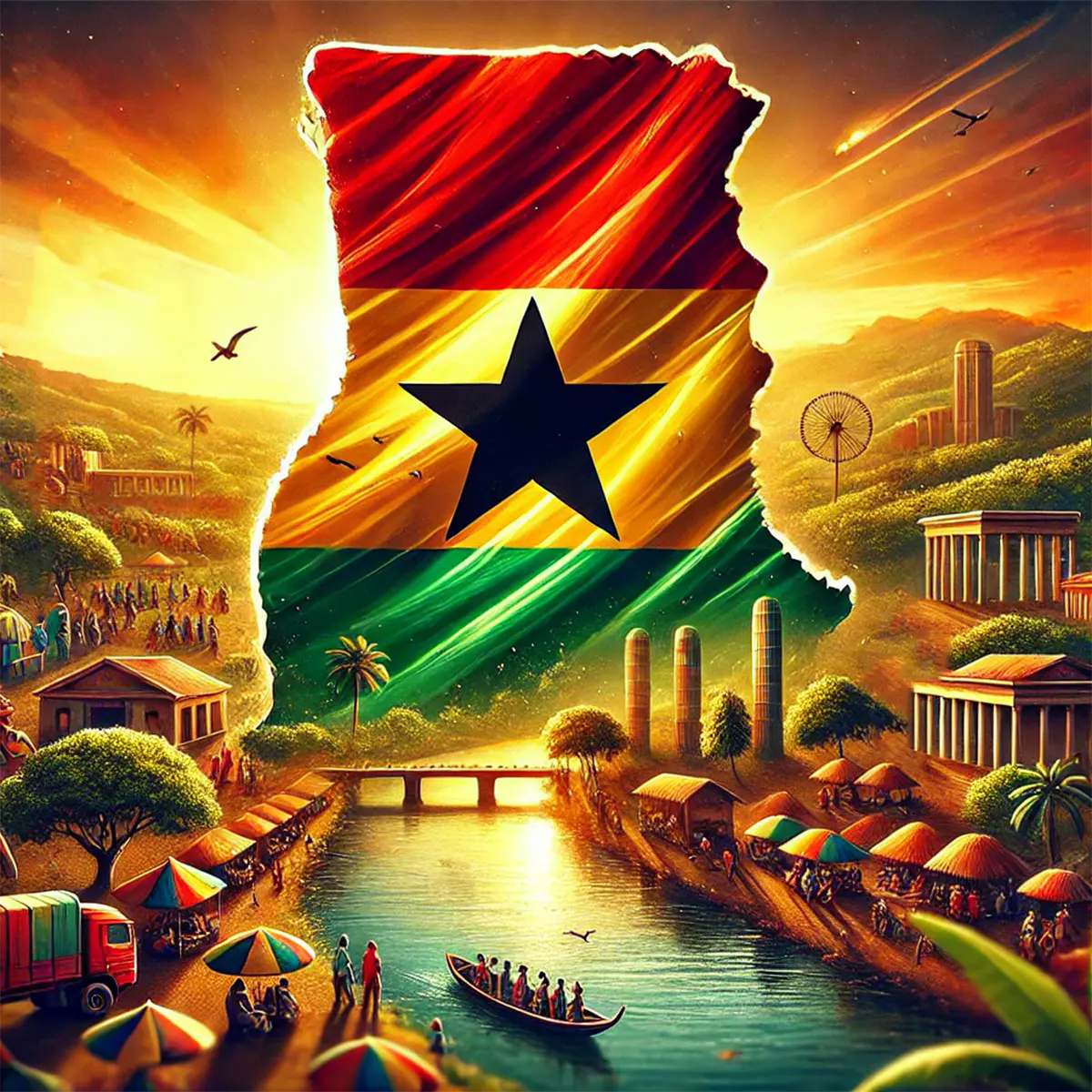
The flag in modern Ghana. Today, the flag of Ghana is one of the most recognizable on the continent. It is raised during state ceremonies on Black Star Square in Accra, at matches of the Black Stars national football team, in schools, embassies and during the Independence Day celebrations on 6 March. The black star has become part of a wider national language of symbols — it appears in the name of the country's main square, in sport, in state branding and in everyday visual culture. In this sense, the flag of Ghana functions not just as a state emblem, but as a short formula for the country itself: the blood of struggle, the gold of the land, the green of nature and the black star of African freedom.
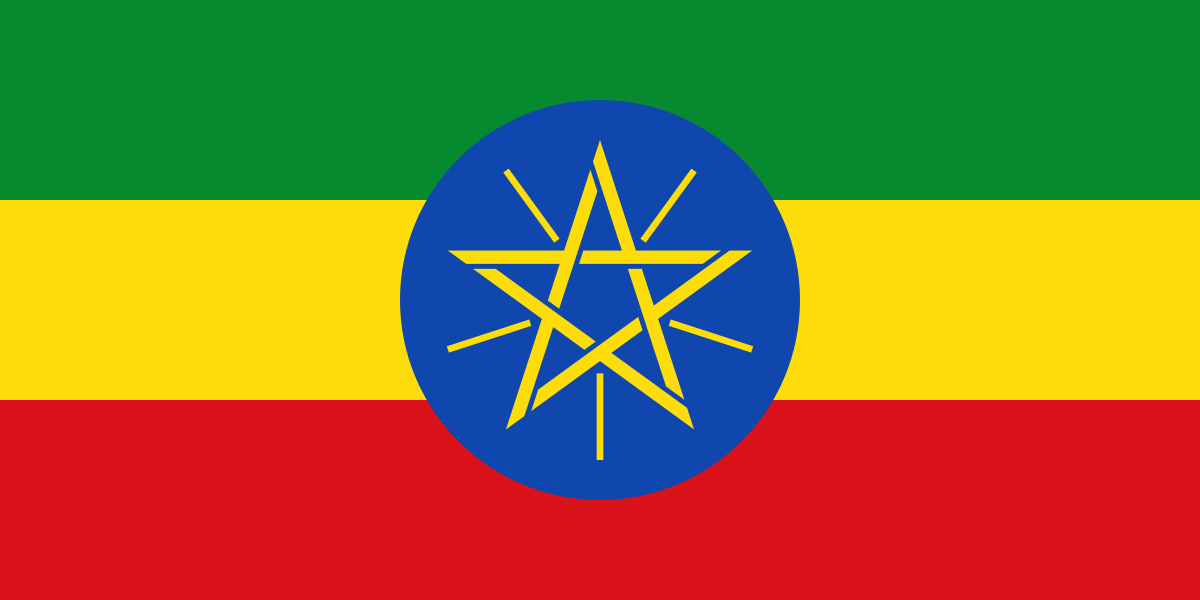
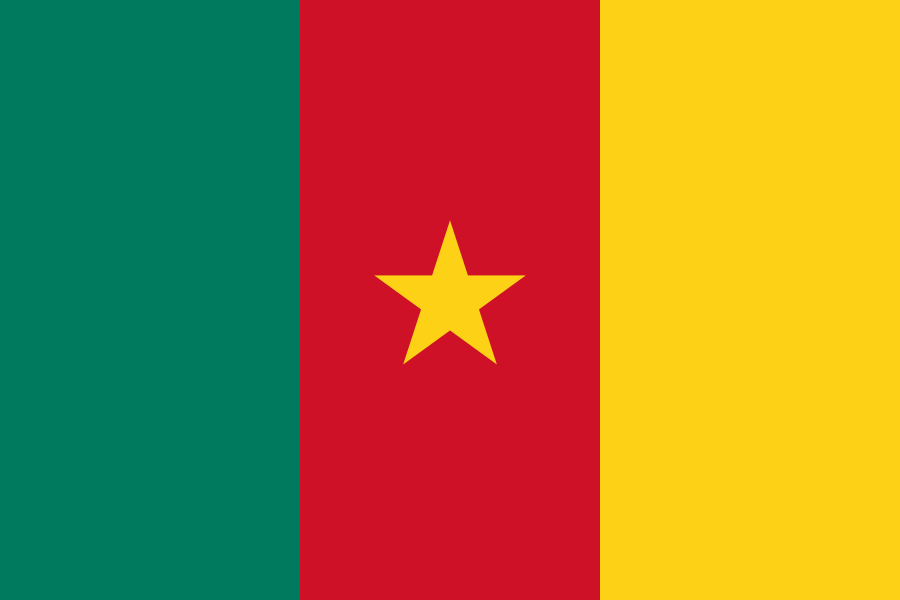
The legacy of the design. It was the flag of Ghana that turned the "Ethiopian" pan-African colors into a globally recognizable code. After 1957, similar palettes were taken up by other newly independent African states — not as direct copies of Ghana, but as a shared visual language of anti-colonial freedom. Thanks to its simple composition and a single powerful symbol at its center, Theodosia Okoh's design has become one of the most influential flags in the history of African vexillology.