Pre-colonial period. Since the 9th century, large Muslim empires existed on the territory of modern Chad — Kanem, later Kanem-Bornu, as well as the sultanates of Bagirmi and Wadai. These states used their own flags and standards — mostly green, white, and black banners with Arabic calligraphy, typical of Islamic sultanates of the Sahel region. The modern flag of Chad has not inherited any visual elements from these historical flags.
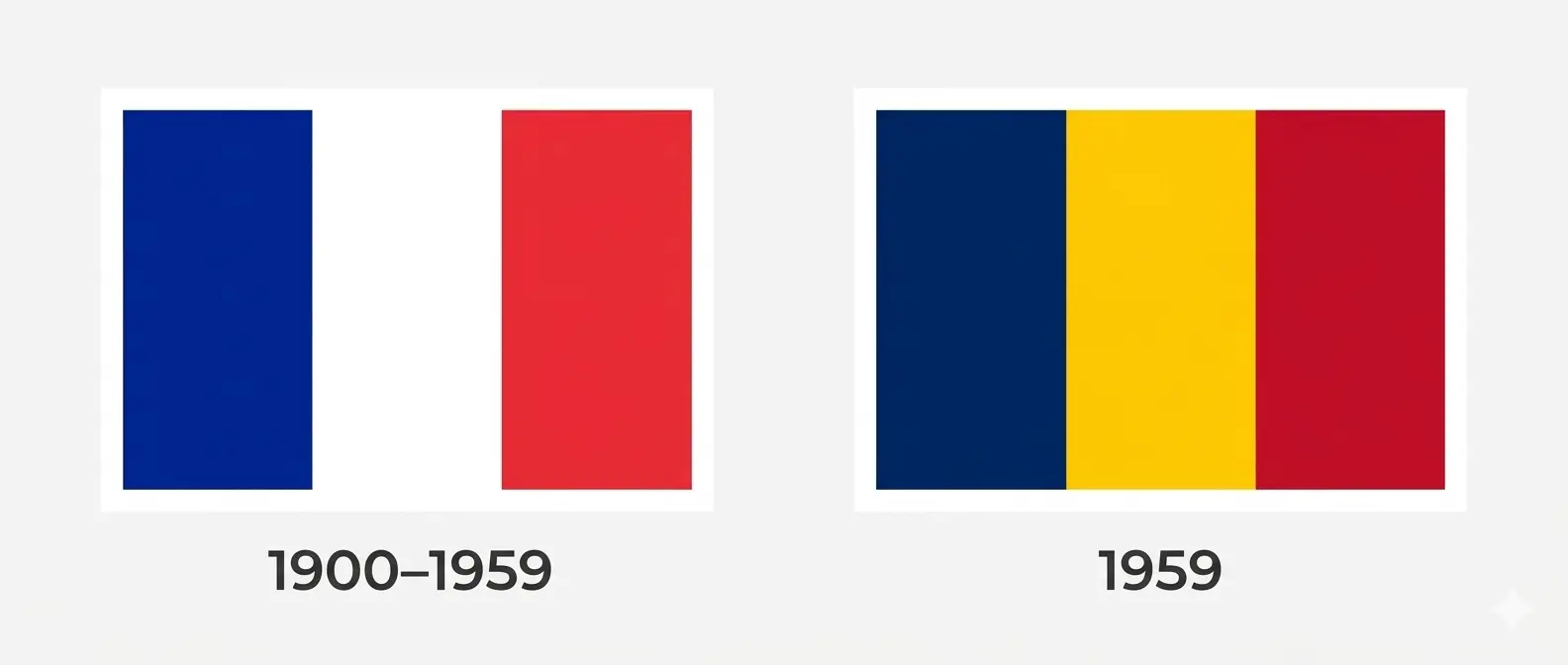
Colonial era (1900–1958). The French began penetrating the region in the 1890s. In 1900, after the Battle of Kousséri, in which French troops defeated the army of slave trader Rabih az-Zubayr, the territory came under French military control. In 1920, Chad officially became a colony as part of French Equatorial Africa. Throughout the colonial period, only the French tricolor was used in the territory — the colony did not have a separate flag.
A separate chapter is World War II. In August 1940, Chad, under Governor Félix Éboué (the first black governor of a French colony), became the first territory to join Charles de Gaulle's "Free France." It was from Chad that Colonel Leclerc's column set out on its historic raid across the Sahara to Libya. This era strengthened the Franco-Chadian ties that were later reflected in the choice of colors of the national flag.
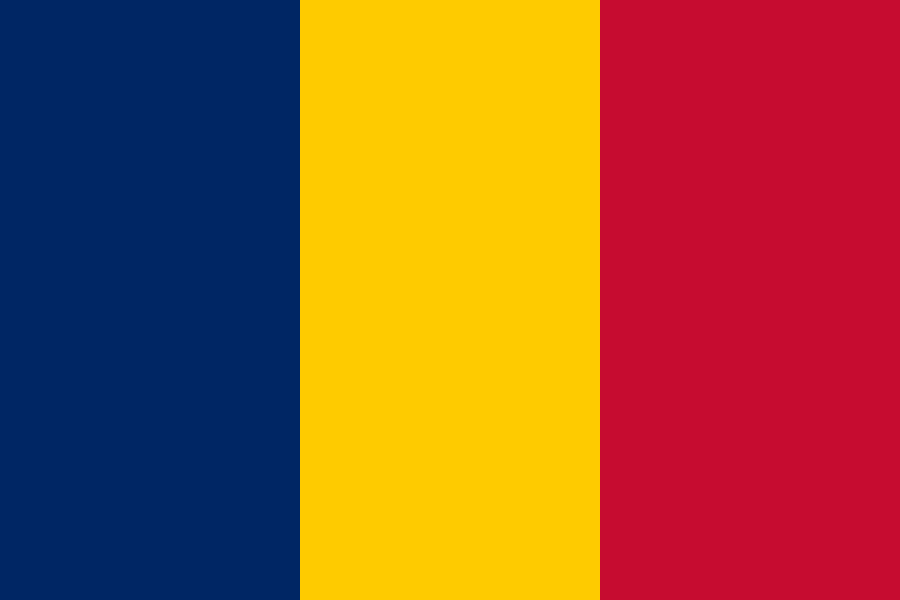
Autonomy and the birth of the flag (1958–1959). On 28 November 1958, Chad received the status of an autonomous republic within the French Community. The question of its own flag arose. The first version, proposed in 1958, repeated the pan-African palette of Ghana — green, yellow, and red — with a vertical arrangement of stripes. However, it turned out that this design was almost identical to the recently adopted flag of Mali (then the Sudanese Republic).
Therefore, in 1959, the Provisional Constituent Assembly of Chad, under the leadership of the first Prime Minister François Tombalbaye, made a compromise decision: to replace green with blue (indigo). Thus arose a unique combination — blue-yellow-red — which simultaneously paid tribute to the French metropolitan tradition (blue and red from the tricolor) and the pan-African movement (yellow and red). The flag was officially approved on 6 November 1959.
Independence and subsequent use (1960 – present). On 11 August 1960, Chad proclaimed its independence, and the 1959 flag automatically became the state symbol of the new republic. Unlike many African countries that repeatedly changed their flags after independence due to coups, revolutions, or ideological shifts, Chad has kept its flag unchanged for more than 65 years — despite the civil wars of 1965–1979 and 2005–2010, numerous coups, and regime changes.
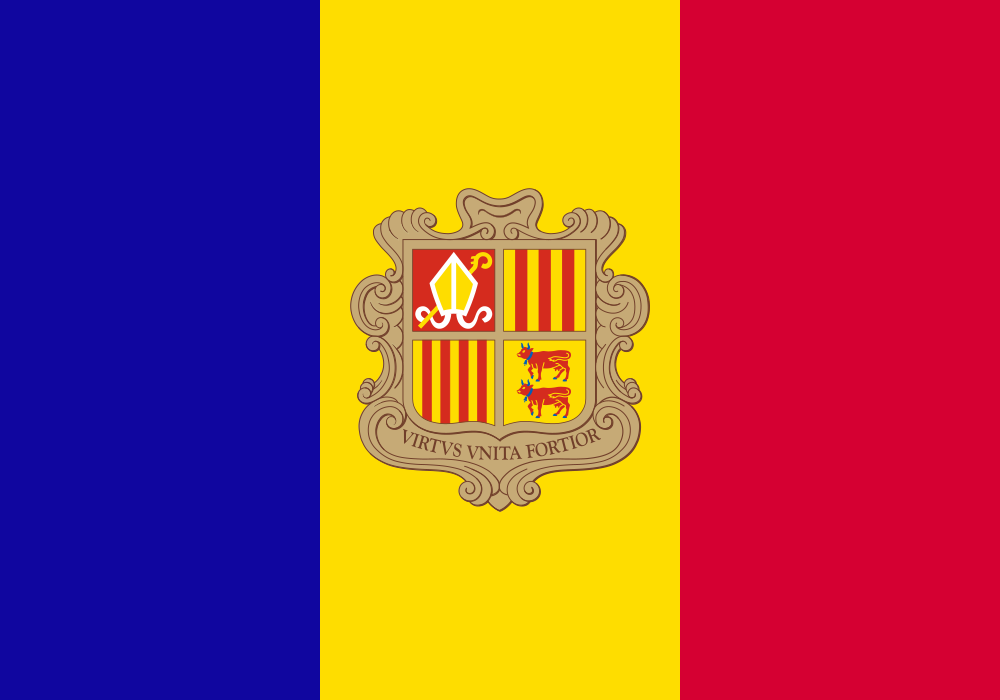
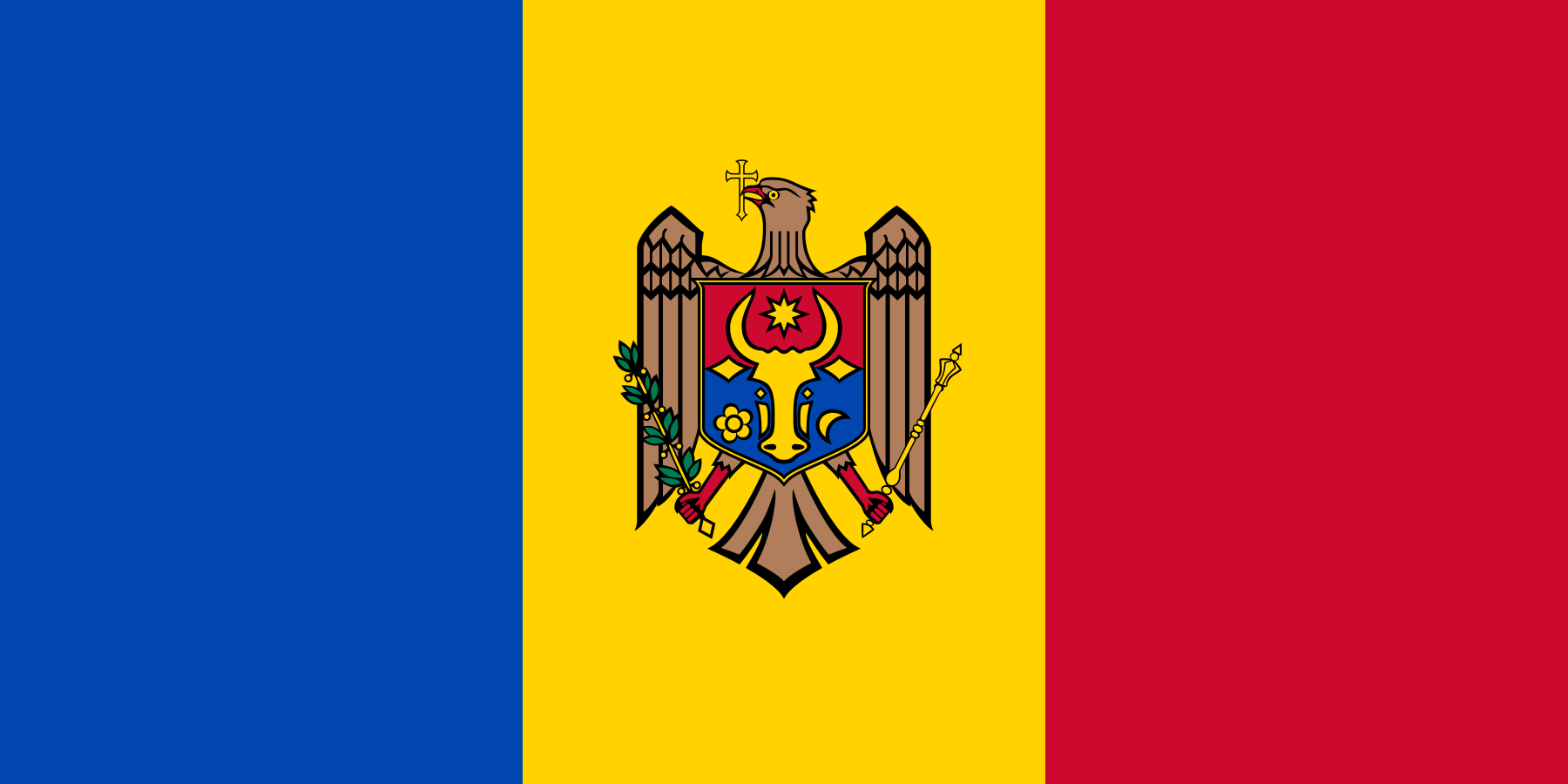
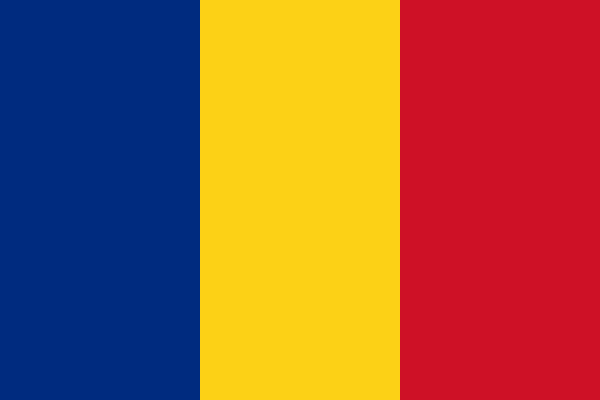
The 2004 diplomatic incident. Until 1989, the Romanian flag had a state coat of arms in the center of the yellow stripe, which clearly distinguished it from the Chadian one. After the Romanian Revolution of 1989, the coat of arms was removed — and the two flags became virtually identical. In April 2004, when Romania was preparing to join NATO, Chadian President Idriss Déby appealed to the UN to consider the situation. Bucharest replied that the Romanian tricolor has a history dating back to 1848 and there would be no abandonment of it. The issue was quietly hushed up, and both countries continue to use almost identical flags — a rare case in international practice.
The present. The flag of Chad remains one of the most stable symbols of the country. It is used on all government buildings, in embassies, on military uniforms, and at national sporting events. Despite the political turbulence of recent decades — including the death of President Idriss Déby in 2021 and the transfer of power to his son Mahamat — the design of the flag has never been questioned.